I’m free now

When I was a kid, I did have happy times. In fact a lot of my childhood memories feel happy. Even some of the stuff that, as an independent-minded adult, I now look back at as creepy or dysfunctional.

I wish people understood that just because someone has some happiness, or feels like things are also good, or has some of what they need (like food or clothes), or smiles sometimes–that doesn’t mean that their situation is okay.

All the dysfunction finally bubbled over. And now, as an adult, a pretty strong person, who has been on my own for years–the effects of my dysfunctional childhood leave me struggling some every day.

Even while I was finding some happiness as a teenager–listening to Ne-Yo and Fergie, watching Modern Family in my closet where my parents couldn’t know, playing out mental fantasies where I actually had friends I got to hang out and spend time with–even when finding my own happiness, I was simultaneously drowning in stress and fear and anger and hopelessness. And all the happiness volume in the world doesn’t somehow balance out toxicity.

It’s good to remind myself that I’ve come a long way.

Now, day to day stresses get to me. I feel frustrated when I can’t slow down and breathe or think, like when my phone rings fifty times in a day. It makes my heart beat harder. Or when I see yucky things on the news. Or can’t see friends face-to-face for the duration of a pandemic. Or keep having to take breaks from running with leg and back pain.

But.

And here’s where I want to sit today:

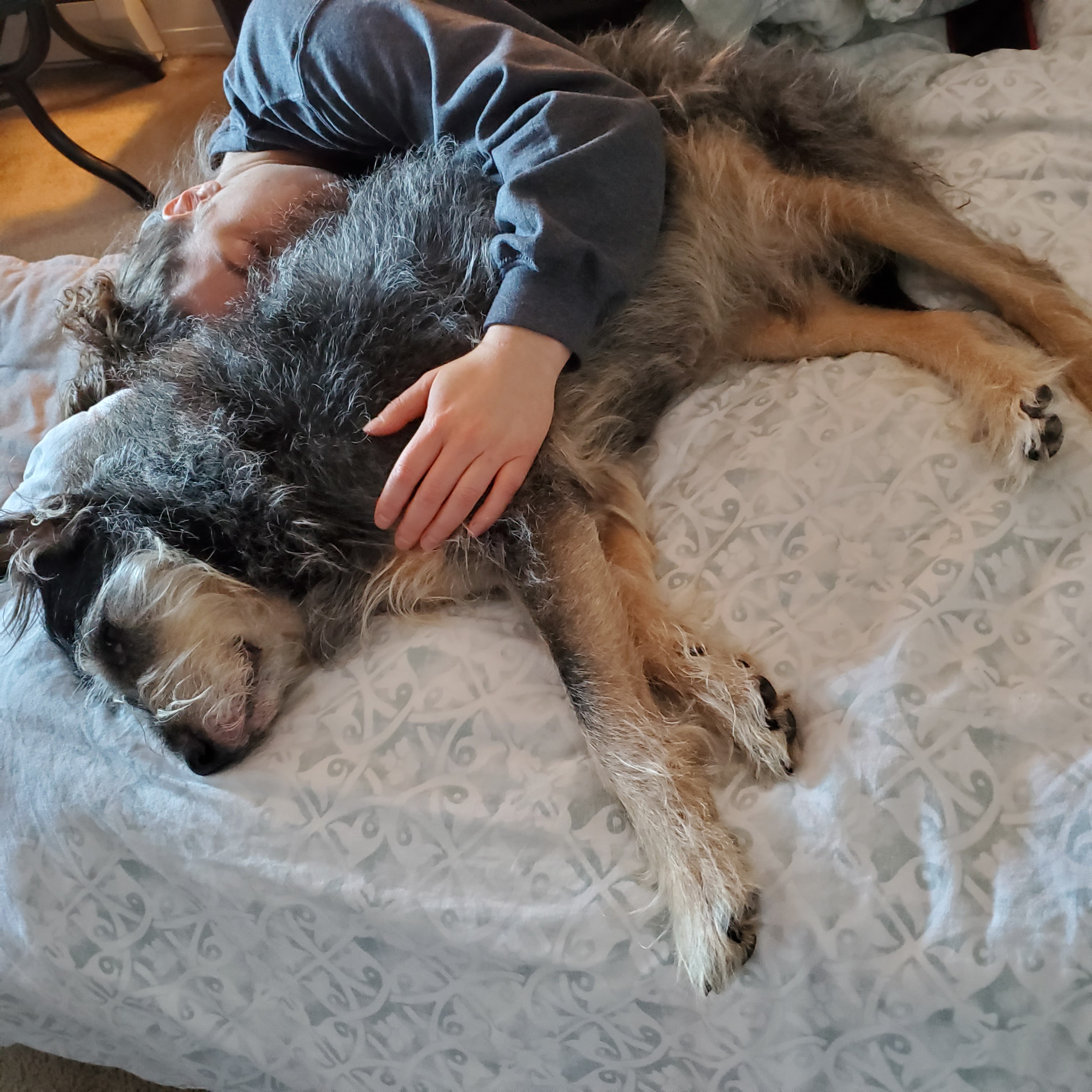
Now, I come home to someone who loves me. Someone who will hold my hands when things feel too big. Someone who lets me have feelings and needs and wants and dreams, and who encourages me to chase them all, even if they’re not her own. Someone who wants to hear me speak from my heart. Someone who deeply values me. And when I walk in the door from a long workday, I have a furry buddy who tells me, with all the whines and jumps and wags and licks, that I am so good and so important. And now I do have those beautiful, wonderful, amazing, fun friends in my life to hang out with that I wished I was allowed to have as a teenager. And now I have all these things in my life and about myself that don’t have a good-or-bad, wise-or-foolish, acceptable-or-unacceptable label to them. Now, I don’t feel like the most important people in my life are ashamed of me for watching my shows or staying up late with my friends or not-still-wanting-to-be-a-preacher-when-I-grow-up, and I never really have anyone raise their voice at me anymore (except, of course, the occasional experience in the any service industry). And nobody snaps at me when I’ve played the same piano piece too many times in a row. And nobody hits me anymore.

The people who don’t love me–I don’t have to be with them. I don’t have to take the phone calls, play the games, suffer through the holidays, bite my tongue at the cruel conversations.

Now, I’m free.

It’s easy to forget how free I am, because nobody graduates from all stress and hurt and struggle, and those things will probably always feel big. It’s easy to forget just how dark things were. Just how NOT free I have been.

Now, life–no matter how lifey it gets, is better. Now, I live with LOVE.

I am thankful for freedom.

I am proud of the courage to step out of toxicity, out into freedom. Proud when I see that courage in myself and proud when I see it in others.

And I am thankful for the life that freedom brings, that courage brings. It’s not too perfect, too fancy. It just has kindness and peace and boundaries and love.

That’s better.

Despite the day-to-day struggles that are a fact of life–has your life gotten better? Have you found some more freedom? Chosen more love? Grown? It’s easy to forget how far we’ve come. And it helps to remember it. Feels hopeful.

What about you?

~

P.S. I know navigating unhealthy family situations is a hard, scary, and misunderstood thing in our world. So much pressure. So many expectations. If it’s something you’re struggling with, I’m happy to listen. And if not me–there is someone else in your life, ready to talk, who has had to step out into freedom. Say your stuff, no matter how messy. Find your freedom and love. Rooting for you!
Emotional on purpose

Non-rational corners of the brain get little respect. We are supposed to be “smart” creatures, do what “makes sense,” “think carefully.” And yes to all that. And also yes to purposefully manufacturing feelings and emotions that access the more primitive corners of the brain and have nothing to do with logic and sensibility.

Here’s what I mean.

“People often say that motivation doesn’t last,” Zig Ziglar points out. “Well, neither does bathing. That’s why we recommend it daily.”

When we plan and think about how to do life day-to-day, we want to grow, stretch, learn, accomplish–and so we tend to put a lot of emphasis on the rationality-stuff, and forget to plan for our emotions.

We are emotional creatures. We do big, brave, beautiful things because we’re having deep feelings.

What gives you those deep feelings? What triggers them? Fuels them? Replenishes them when you’re running on empty?

Reading a good book? Singing along to the Les Misérables score? Discovering a new poet? Getting the biggest, tightest hug? Asking your heart how it’s doing and writing the answer in a journal? Volunteering to help people in need? Laying quietly for an hour by the lake? A phone call to your best friend? Reading a story that deals with death or loss or grief and purpose? Finding a good quote to live by? Gazing at photos of Mount Ida, visualizing yourself, hiking boots, backpack, all geared up, trekking the wilderness? Joining a crowd to dance, sing, cheer, laugh, or some years just seeing a bunch of smiling faces on Zoom? Holding the little hand of your sweet kiddo as they drift to sleep?

We call them “mountain top” experiences, and they change our lives, and then, when the feels wear off, and we’ve been feelingless for a good while, and we got all rational again, and we barely recognize our once-emotional-selves, we remember those episodes and call them “mountain top” experiences again but with a sort of disapproval this time, like we had fallen for something, like how silly to get so high on feelings. Or maybe like we’re just feeling insecure and a little lost deep down now, because we can’t find our way back up the mountain.

So get emotional on purpose.

What gives you those deep feelings?

Do it,

plan it,

schedule it,

repeat it,

commit to it,

obsess over it,

enjoy it,

cry about it,

share it,

keep it sacred,

ritualize it,

commemorate it,

do it again,

do it again,

do it again.

Let’s not undervalue the truly life-changing impact of finding our feelings.

What emotions do you need today? And where could you get them? Go look, find, take them.

There is nothing silly or senseless or worthless about manufacturing vitality-giving emotions on purpose.

We’re creatures with feelings.

Feel on purpose.

The problem with being good at running away from lions

Humans are good at running away from lions. (Like, yes, a lion’s gonna catch us, but we’re good at trying.)

Danger equals adrenaline equals quick speedy fight or flight. Human bodies are good at this.

Some people grow up running away from lions every single day. Lions that sound like dad yelling again or the cool kids taunting you again or your relationships failing you again and again. Every day is scary and unsafe.

Traumatized people get really good at running away from lions.

Problem is, to a traumatized person, everything begins to look like a lion.

What good things have you been running away from?

2 impactful things to do every day–ONLY 2

The other day I sat down and wrote a schedule that would help me actually do all the things I want to do every day, every week. I did that a while ago, too. And before that. And again and again and again. And it HAS HELPED. Every time. But it has never “worked” impeccably. Schedules, to-do lists, planning sessions–they’ve never guaranteed lasting consistency in my life. I’ve had to keep trying again.

Like in meditation, where you keep wandering, so you keep gently redirecting your mind.

For years I saw the ebbs and flows of life as a weakness. And “weakness” meant BAD. I don’t really see it that way anymore.

Life comes in waves. In cycles. In “I’ve-got-this” weeks and “I-can’t-even” weeks. And I’m thinking, more and more, that . . . c’est la vie.

Imagine the alternative: Being ALWAYS ON. Going at the same pace through all of life. Never feeling the low times again. Never taking a break from your productivity. Never understanding the “struggle” that all your friends and family experience. Being perfectly consistent. I don’t think that’s how life works. In fact, I think the cycles help us self-regulate, and help us change with life’s seasons.

The cycles in life help us make little mini-course corrections–or sometimes not so mini. Sometimes my heart or my body or my subconscious says something like “Hey, too heavy on the socializing these days,” or “I think you might need to slow down,” or even “I think it’s time for something a little more meaningful.” And then for a while, I become a little more this and a little less that. For a season. Until it’s time to correct again.

In other words, it’s okay for life to be up and then down, back and then forth, busy and then slow, happy and then sad, productive and then relaxing. It’s okay that today-me and tomorrow-me and next-year me are each going to be a little different.

Let yourself not be always “on.”

Let yourself change. Let yourself throw caution to the wind today, stay in bed all day tomorrow, and then go conquer the world the next day.

In the context of that disclaimer, and only in the context of that disclaimer, I’d encourage you to try two little things every day. The mountain-top days and the valley-days. Two little things with big impact:

First, keep one centering ritual:

One thing that brings you back to who and where and why you are. Some days the ritual will open your eyes to exhaustion in yourself, and some days the ritual will open your eyes to an almost limitless energy. How important to know which days you need a break and which days you need to give it everything you’ve got! Some days the ritual will show you that you are at peace, and some days it will show you that you’re torn. Good! You know what you’re working with! It’s about slowing down and seeing you and your world.

Over the last several years I’ve learned that for me it’s a mixture of quiet time, meditation, and yoga. And if I can do it first thing in the morning, I will be so much more present that day. Not always more “happy” or “productive,” just more present in reality. Able to show up for my real life instead of wishing it away.

What is that centering ritual for you?

And second, keep one difficult ritual:

Being who we want to be every day, choosing our reaction to life’s roller coasters, takes strength. And not the strength to choose “positivity” every single time, or to choose “productivity” every single time. Just the strength and discipline to say, “Today, I think this is what I want or need,” and then to follow through. Don’t underestimate the power of doing one difficult thing–maybe even one “painful” thing–every single day. If you were able to do that tough thing–that thing you don’t “like” or that didn’t feel good . . . then when the consequential choices show up later in the day, the opportunities to be who you really want to be . . . you’ll remember that you are strong!

At times, for me, that has looked like really uncomfortable running training. Pushing myself past what I thought my limits were. Keeping up that pace even when it’s not “fun.” I’m not always a proponent of that, but it has had its incredibly effective place in my life as a tool for learning discipline. The correlation between the running-as-discipline and making-the-choices-I-really-want times of my life has been pretty shockingly close. Lately, it’s been wrapping up my morning shower with a blast of icy cold water and just standing under it for a while while I find my controlled, capable breath. It just proves to me first thing in the morning that today I can pick the uncomfortable option or make the tough decisions or do the scary things if I need to.

What is that difficult, strength-finding ritual for you?

Good luck, my friend, as you show up for your life and choose to be the Light you want to be in the world, every single day. And it’s okay that it will look different day to day. Just don’t lose YOU in all the waves.

~ namaste ~

P.S. And if you ever do lose you, just wake up the next morning, check in on your heart, and take a cold shower.

P.P.S. You’ve got this!

Peter Elbridge - can't be always on can be always you

The coming “new normal”

My friend Madonna pointed out this morning that as cities and states across America gradually start opening back up, each in their unique way, we are going to start seeing what the real new normal will look like.

For a long time, many people are going to be living in heightened caution. Wearing masks, avoiding large groups, hugging a little less (unfortunately), and the list goes on.

Massive world-changing events drive cultural shifts. It’s happened time and time again through history. Humanity comes out on the other side of massive events with collective changes: New widespread traumas; Heightened awareness of different issues than before; Increased and even urgent motivation for ingenuity and innovation; Maybe a little more consciousness. . . .

And it leads to new cultural flavors and norms: Widespread increases in security; A change in financial priorities, like saving money; Outspoken support of human rights that were once overlooked. . . .

A couple months in, over the first big hump of crisis and shock and solidarity, we notice that the masks aren’t going away any time soon. And we notice that even after they say “you can be together again now,” people still have this uneasy doubt and confusion over what and where is safest, over whether this or that friend is still too uncomfortable, and over when it’s going to be okay to hug again.

So, as my friend pointed out this morning, it’s sinking in that we are not going back. By the time we even could go all the way back, we’ll be a changed world.

There will be collective trauma. Loss. Fear. Changed priorities. Stress.

But what else will the new normal look like? The long term new normal? The world as it comes out on the other side of this pandemic–what will that new normal be?

Before you answer that, stop and think about two interesting points:

First: How does a trend start? A person does a thing. A weird thing. A new thing. A not normal thing. Quite possibly a brave thing. One person. ONE person. Somebody is the first one to do it. That is how a trend starts. That is how new practices start. That is how a tradition is begun, how a cultural norm is born: ONE person does a thing.

Second: Have you ever lived through a time of such widespread understanding and acceptance of whatever-the-heck-you-have-to-do to get through this? Suspension of judgment about how emotional and mental needs are met. Everyone suddenly getting super creative. Psychologists and non-psychologists all rushing online to say “IT IS OKAY IF YOU NEED TO [fill-in-the-blank] RIGHT NOW.” Or “IT IS OKAY IF YOU CAN’T.” In other words . . . all of a sudden, people are calling foul on “Expectations,” walking away from arbitrary standards of what works and what doesn’t. As everyone’s worlds have imploded, humanity has granted itself a free pass on being “normal.” Normal isn’t a thing right now.

Recap . . . First: ONE person can start a “new normal” thing. Second: All “new normals” are currently being accepted.

Can I just suggest that there could not be a better recipe for cooking up a beautiful new normal?

And that every single one of us gets to help decide how that new normal is flavored?

What are we going to put into the mix?

More friendliness? More vulnerability about things like personal struggles and mental health? More meditation? More conversations? More quiet time and down time? More acceptance? More smiles? More outdoor time? More volunteering? More concern and action for the people who need help or are hurting? More respect? More equality? More generosity? More kindness? More solidarity? More compassion? More diversity? More asking “No really, how are you actually doing?” More love?

What are you going to start doing right now, while everyone is allowing it?

What are you going to stop doing right now, while nobody is counting on it?

You actually get to be a part of creating the world’s new normal.

What’s your first ingredient you’re going to mix in? Message me, comment here, call a friend, post it on your story . . . say it out loud, embrace it, run with it: What are you going to bring to the new normal?

It’s ours to shape.

~

P.S. I’ll start. I’m going to say hi to strangers more and check in on friends more. Love to you all! <3

P.P.S. Thanks for the inspiration to start thinking about our new normal, Madonna, I want to hear yours! ;)

20190628_133442