What we got wrong about love

I don’t remember what game we were playing, or what this little boy was having a tough time with, but I remember like it was yesterday watching his father get more and more frustrated, eventually losing his temper and snapping at his sweet little boy. They were on a team and they were losing and the little boy wasn’t playing well enough–and this, apparently, was a big deal. That’s how it went in public, so you can imagine what the little boy heard every day about his worth at home. And now this little boy isn’t so little anymore, but he still says the word “sorry” constantly: any time there’s the teensiest chance that he’s disappointed anyone, made a mistake, or even just when he’s waiting for someone to be mad at him for no reason. He’s sorry for everything, because he knows–more deeply than he knows almost anything else–that who he is isn’t good enough for the people who “love” him.

I don’t know if you believe in a god, but I’m sure you believe in Love. I grew up believing that there is a god and that this god absolutely hates everything besides absolute perfection. Which is weird, because I also grew up reading a holy book that states, “god is love.”

This is not about whether I believe in that god anymore, or a different god, or no god.

I want to write about the impact my belief system had on my day-to-day notions of “love,” and the ripple effects that has had on each area of life.

I’m guessing I have lots of fellow humans whose unique worldview experiences or social experiences have led them to internalize similar notions about “love.” (I’ll try to sum up these love-notions a little later.) If you find that this speaks to your own experience, I’m writing this for you. And if you find that this sounds like the experience of someone you love, I’m writing this to help you understand and be with them.

~

What I learned about love, you can learn in lots of different ways:

You can learn it, like I did, from living in a world where everything has a specific spot somewhere between good and bad on a moral scale. We believed we had a very clear understanding of what was the holiest and most excellent way to do or say or believe–everything. It led to deep, guilty soul-searching episodes when someone would ask, “Is this the best use of your time?” Because it probably wasn’t. And if it wasn’t, you were probably disappointing god. “Best.” It’s why you had to sit with your family in church, not with your friends, because symbolically that was the most god-honoring way to do it (and, anyway, sitting with friends might corrupt you). It’s why we talked on our way home from church about how much we disapproved of those families who did let their kids go sit with their friends in church. It’s why we couldn’t play sports. It’s why we mocked people who worshiped with “shallow,” “worldly” contemporary music. It’s why I realized, as do many of the males who grow up in a similar worldview, that I was “called to be a pastor” (minister, if you’re not familiar), because even if we didn’t attach the word “best” to it, we would attach words like “highest calling.” I just know I got more attention and support for wanting to be a pastor someday than I did for wanting to play baseball. This was just the world we lived in. Doing and saying and pursuing and loving only the “best” or the “best way” was the obsession of our everyday lives.

You can also learn the same lessons about love from parents who are really mean to you. If you’re being constantly criticized, constantly yelled at, constantly mocked, constantly put down, constantly shamed–and especially constantly compared. Compared to your other siblings, compared to your parents, compared to your friends, compared to successful people on TV. Albert Einstein is attributed with saying, “Everybody is a genius, but if you judge a fish by its ability to climb a tree, it will live its whole life believing that it is stupid.” I don’t know if he actually said that or something similar, and I know that “genius” has more than one definition, but do you sort of get it? There is a beauty and worth in every unique individual. But some of us grew up in homes or ended up in jobs where people were always mad at us because we couldn’t climb trees, but they didn’t bother to discover how well we could swim. Maybe you weren’t “smart” enough. Maybe you weren’t “athletic” enough. Maybe you weren’t “extroverted” enough. Maybe words like “klutzy” or “daydreamer” were used derogatorily about you a lot. Maybe you were happier just reading a book alone in your bed, so your family or friends called you “boring.” So you learned that you weren’t quite as worthy of love as someone smarter, more athletic, more extroverted, more fun, etc. The most deserving of love–the most lovable–are the ones who are most those-things: extroverted, smart, athletic, fun, funny, talented, “interesting.” (“Interesting” is a dangerous adjective when we use it to compare people.) Maybe you kept your version of you and you think it’s unlovable. Or maybe you fixed yourself by switching to the version of you that is all those better words like “smart” and “athletic” so that people will love you, but you don’t feel like you anymore, and now you’re training the next generation that only the “best” are worthy of love.

You can learn this dangerous version of love from being in a family or social circle that gets most of its pleasure from making fun, bullying, mocking, teasing-but-really-not-just-teasing, and criticizing others. For some, life seems to be about who we can laugh at today, who we can shake our heads about and say things like “how do they live with themselves?” or “I’m glad I’m not like them.” Humor is a complicated subject, because making fun of people who are different or uncoordinated or “dumb” or “stupid” can be so, so pleasurable. And so, so dangerous and hurtful and sad. There are lots and lots of videos on the internet of genuinely hilarious accidents and situations that people have found themselves in–harmless. And there are just as many videos of people who have found themselves in confusing, embarrassing, or frustrating situations and are being taunted by the rest of the world–not at all harmless, but so easy to laugh at. Maybe you and your siblings or friends found your identity in entertaining each other with running commentaries on the stupidity you saw all around you: Ignorant people, confused people, tongue-tied people, nervous people, lazy people, vain people, “fat” people, “ugly” people. The world was about judging others. Happiness was found in making fun of a “stupidity” that thank god you didn’t share. And now what you know about love is that love is for the “best” ones, the “good” ones, the “talented” ones, the ones that won’t be the butt of a joke.

You can pick up these dangerous notions about love from growing up in a home where everything is about being wealthier than the rest of the world, more successful, more academically inclined. You find that you don’t fit into this world, so you are less lovable. Or you find people in the outside world who don’t fit into this world, so you can’t love them as much.

In the end, this idea about love that come with words like “best” and “worthy” and “disappointing” and “different”–these ideas can come from worldviews and experiences that put any different version of “best” on a pedestal: Religion, morality, health, sports, money, intelligence, style, popularity . . .

And this idea is sometimes imposed on us by people who are motivated by feelings of hate. But they’re also imposed on us by people who are motivated by feelings of love. “I want the best for you, so I will protect/teach/push you by . . .”

In a nutshell, this damaging notion about love that so many of us have learned is this: Love needs a reason.

“I will love you if . . .”

“God loves you if . . .”

“I will be disappointed in you if . . .”

“You’re stupid if . . .”

“I will be so proud of you if . . .”

“You’re my favorite because you . . .”

“I love you because you are the best at . . .”

“I will support you if . . .”

“I will disown you if . . .”

And it sometimes goes one step further. “Love needs a reason, and each reason falls somewhere on a scale.”

“You’re the most . . . in the family.”

“You’re so much smarter than . . .”

“You’re so much more beautiful than . . .”

“You’re not as . . . as you used to be.”

“You’re not as . . . as she is.”

“You should be more . . .”

“If only you could . . .”

“I would love you more if you were less . . .”

I honestly think this idea matters a lot. It’s such a deeply rooted part of what love and worth mean to so many of us, and it has real and sometimes very sad effects.

Deeply internalizing the idea that your own or someone else’s worthiness of love is dependent on where they fall on a scale of worst-bad-good-better-best impacts our mental health and our relationship with ourselves. It impacts how we feel about entire people groups and the world as a whole. It impacts how we bond and interact with our social circles. It impacts our relationships–especially our closest ones. And it seriously impacts how we experience all the little (or big) things in life, like art and adventures and cups of coffee.

~

There are a lot of personality traits that society has largely endorsed as “better” or “normal.” I think that collectively we are slowly getting more accepting about these things, but generally, being “not normal” in certain ways comes automatically with a feeling of “bad.”

Deeply introverted people and people with sensory processing sensitivity can find it difficult or impossible to function in many settings. If I’m such an introvert that I literally can’t even process the fact that you’re loudly saying words directly into my face in a crowded restaurant, I very likely feel a lot of shame for being this way. Like I’m letting you down. If that’s you, maybe your parents told you that you had a bad attitude or only cared about yourself, or your friends told you that you weren’t any fun. Or maybe they all said “oh that’s okay that you’re introverted,” but you could tell for sure they actually meant “we can put up with this, but you’re definitely not our favorite.” Either way, at least until recently, introversion has been treated like it’s a bad thing and introverted people have often been left feeling misunderstood, lonely, ashamed, and “less than.”

Until very recently, if you were attracted to someone of your own sex, you were likely completely rejected by family and friends. Or maybe you were “accepted” but like in the “isn’t this amazing that we still accept you???” way that makes you feel just as rejected. Sexual orientation had such a central spot on the bad-worse-worst scale in the world I grew up in that I remember one time being told not to use the word “homosexual” because “it’s so evil it shouldn’t even be named.” So many people have accepted the message that they are less worthy or unworthy of love because of their sexuality.

Any and every kind of “fitting in” is so important to us that we reject the parts of ourselves that don’t match the “normal” we see around us. We learn to be embarrassed about making unusual life choices. We get self-conscious about being “different.” We try to reshape every unique part of ourselves until we can feel like one of the “normal” people. I love singing, and sometimes I quietly sing in my office. On self-conscious days I don’t let myself sing, and that’s sad. On days I embrace my “weird,” I get to enjoy that part of me. Another not-normal thing about me is that I have a really hard time understanding teasing. Very often I hear things as really serious (or at least seriously passive aggressive) that were meant as affectionate teasing. This is a noticeable enough part of my personality that for a while it became something I felt very embarrassed and ashamed and guilty about. Like I was defective.

We all have unique us-things that aren’t normal-things. And if we learned that love needs a reason and that love needs the best reasons, our unique us-things leave us feeling ashamed, embarrassed, inadequate, and lonely.

So “not normal” equals “bad.” But it’s more than just that. We have legitimate “weaknesses,” or aspects we identify in ourselves as areas where we want to grow or change–even if we know it’s “normal” to have these weaknesses. An internalizing of the “you-have-to-be-worthy-of-love” message means that we equate having these weaknesses with the generic label of “bad.” If something about me frustrates myself or causes stress for my significant other, that makes me “bad,” or at least it is a “bad” thing about me. And that is very sad, and it means you probably can’t love and accept me, and so I feel helpless and vulnerable and threatened and unlovable.

Weaknesses aside, even my strengths and my accomplishments and my good-things have to be the best! One of the most common phrases I remember hearing growing up was, “Is that really the best use of your time?” And that question lodged deep in my psyche. As an adult it has left me dealing with chronic tension and anxiety about doing all the best things, making all the best choices, “redeeming the time” as I learned to call it. It meant that relaxing was bad. It meant that getting lost in a story for the story’s own sake wasn’t worthwhile. It meant that playing video games with friends was a waste. And even as my values and beliefs changed, the old “bests” were simply replaced with the new “bests,” and I began feeling guilty for going a day without learning some big thing or without writing or without going to the gym. Every choice and every day has to be the “best.” My whole life has to be the “best,” so the idea of a career where I’m not making this huge impact on the lives and hearts of so many people was just not acceptable so I never bothered to look into acting even though deep down it was like my favorite.

Perfectionism. Workaholism. Obsessive dieting. Over-commitment. Dissatisfaction. Competitiveness. Fitting in. Stoic toughness. All these ways we are compelled to tirelessly grasp for “best” so that we can be happy with ourselves and so that others will be happy with us. That’s a lot of “best” to keep up with, especially because we never quite think we’ve reached it.

~

This subtle idea that love requires a reason affects how we see the broader world, too, from humanity as a whole to specific people groups. People who “talk that way” or “dress that way” or “spend that way” or “think that way” or “look that way.” People who struggle, people who “fail,” people who are vulnerable, people who need help, people who are “different.”

We alternately fear and scorn “those people.” Democrats or Republicans. Immigrants. “Blacks” or “Mexicans” or “Middle Easterners.” Men or Women. Boomers or Millennials. “Filthy” rich. Homeless. “Fat” people. Sensitive people. Dreamers. Network marketers. Christians. Atheists. Parents. Politicians. Auditors. Celebrities. Rednecks. Rebellious teenagers.

We find a label that we’ve experienced as somehow “bad” or “less than,” and we assign it to a group of people we don’t know–humans just like us deep down–and then we get to hate them, reject them, make fun of them, mistrust them, attack them, write them off, bully them.

The idea that some groups of people are less lovable because of who they are or what they’re going through is the very antithesis of compassion. We mock and make fun and build walls and forget that all these people are just humans who, like us, at their core are just vulnerable souls in need of love and support.

~

Love needing to be deserved impacts our own social circles, too. One way I’ve noticed I carry with me this only-love-the-worthy-ones baggage is through my deep down gut reactions to people who hurt me and let me down, even in little ways. I’ve noticed that I learned a tendency to see only one or the other: someone that doesn’t hurt me and I love them, or someone who hurts me and I hate them. There’s no room for people that I love and also am mad at sometimes, because once they’ve hurt me they’re “bad” and it’s simplest to just reject them and move along. Either someone is the “best” or they are unsafe. Only the “best” are safe.

Sometimes it’s not about safety, sometimes it’s just about preference and popularity. We learn socially to accept and appreciate and embrace and follow and enjoy the “best” people, and neglect the “less-thans” out there. It’s why even in many social groups that try to be built around “love,” like some churches, the “odd” people–the socially awkward or the mentally ill or the addicts or the handicapped–are left out of the cliques. We gravitate toward the people whose style and company we consider the “best,” and we happily leave the “odd” ones to fend for themselves.

This perfectionist view of love also tends to really rub other people the wrong way. When I take issue with everything that isn’t quite perfect–when I always, always, always point out the errors or the weaknesses around me and look for reasons to criticize every single thing–well, it’s just not how to win friends and influence people. My accepting and loving only the “best” things doesn’t work for my friends.

~

Perhaps most sadly and painfully, this idea that love needs a reason can slowly erode your relationships–especially your closest ones.

Back to the idea that “not normal” equals “bad.” Nobody will get to know your significant other better than you will. And you won’t get to know anybody else in the world as well as you know your significant other. Which means that you see the “not normal” highlighted in your significant other so much more closely and loudly than you see the “not normal” in other people you like and look up to. And when some of those “not normal” things about your significant other start to get under your skin–which, for the record, being annoyed can be completely understandable and healthy–it is so easy to forget that your view of your significant other is what it is only because of your vantage point. When you compare your significant other’s insecurities to your other friends’ insecurities, your significant other loses this comparison. When you compare your significant other’s anxiety or mood swings to the anxieties and mood swings you’ve seen in other people, your significant other loses this comparison. Every “imperfection” you see in your significant other, you see so much more closely than you see it in anyone else. And that can eat away at your feelings of love and acceptance and patience and compassion. You can become frustrated and quite understandably discontent. You can feel panicky and stuck. “Other people don’t seem to have this problem. If only I could be with other people.” The reality is other people do have this problem and other problems, you just see your best friend’s “bests” and “worsts” from a front row seat.

In the context of people needing to be worthy of love, realistically recognizing your best friend’s imperfections means you have found a “problem,” and instead of love there is doubt and fear and mistrust.

As compassionate and accepting as you determine to feel toward you significant other, whose insecurities and weaknesses you get to know so deeply–if you have internalized the lesson that you need a reason to love someone, you will find reasons not to love. And you will experience times where you have lost sight of reasons to love. And in those times, if your love for your crazy best friend has to “make sense,” you won’t be able to find it.

Chances are you’ll be right about your best friend being a little heavier on the weaknesses than a few other fantastic humans you’ve met. When you fell in love with your best friend, they were “the best person in the world.” But there’s a good chance that someday you’re going to come across someone that you see as “better.” Maybe a new person has those characteristics that attracted you to your best friend, but even more strongly. Maybe your values have changed as you’ve grown and this new person’s compassion or their healthiness or their ambition is more attractive to you than your best friend’s.

In a world where you’re supposed to save your biggest love for the people who have (in some arbitrary way) earned it the most, best-friend kind of love and safety and togetherness and got-your-back-ness doesn’t work.

Flip the roles for a minute. Your partner fell in love with you “because of your ambition” or “because of your sense of humor.” You know there’s someone with more ambition than you, or someone a little funnier. But you need your partner to still love you anyway. What you really need is to just be loved for you. No matter how you compare to the next person.

There’s nothing wrong, I’m sure, with being attracted to someone’s traits and strengths and accomplishments and style to the point that you “fall in love.” Love has reasons. I just think love can’t totally need reasons. Because there will always be a “more reasonable” person to love, but humans were made to provide love and safety for each other–and not just for the “best” each-others.

Love needing a reason–love needing the best, the most worthy-of-love things to love–is a fragile, hurtful, loveless love.

~

Beyond our relationships with ourselves and others, being obsessed with comparing lovableness and worthiness and good-better-best-ness just practically drains life of its zest.

The world is full of magic. But we miss most of the magic when we obsess over the “best,” when we only love the things that “deserve” to be loved.

We scroll and scroll and scroll through Netflix looking for the-just-right TV show with it’s just-right humor that will put us in the just-right mood that we felt that one “best” time. (And, of course, we land on The Office and commence our thirty-fourth rewatch, because, despite all I’ve written so far, if there ever was a “best” and “most-worthy-of-love” thing to be exclusively embraced, the Office is it. Or maybe just because “favorite” is okay, too.)

We stress and stress and stress over our choices, desperately needing to make sure we’re making the most right decision that will lead us to the most happiness.

We criticize most things because they’re not the best. We’ve seen better.  Besides one, every single cup of coffee becomes “not the best cup of coffee.”

We mostly notice the “dumb” parts about each movie we see, each song we hear, each painting we look at. Because we’ve become wired to “discern,” to have “high standards,” to seek the best of the best of the best. Always. So we criticize almost everything in the world. All things but the best things are unsatisfying.

Once, when I was a teenager still living in a culture defined by a comparing/earning version of love, something struck me. And it’s a little dorky, like debate-kid-argument style dorky, so bear with me. This worldview of “god-accepts-only-the-very-best” and “only-the-most-excellent-is-pleasing” that I had grown up with, applying it so faithfully to each and every activity and choice in everyday life–its logical conclusion can only (and quite absurdly) lead to a world where we sing one and only one “hymn” to worship god–whichever we discover is the “best,” the most “beautiful” and “pleasing” to god. We’d only read one book, the best book. We’d only ever spend time with one friend, the best friend who had the most positive influence on us. Of course, this was absurd. Which meant, of course, that this notion of love and worth that I had grown up with was not an actual thing. It didn’t work. It wasn’t life. Life is bigger and broader, beautifully diverse and colorful, and full of countless uniquely lovable people and songs and places and styles and tastes and stories and choices and relationships and expressions.

The “best” just isn’t important. It’s not really even a thing.

~

Can I ask you a question? Like a real, honest, uncomfortable, stop-and-think question. If you learned this lesson about love–that love needs to be earned, that the biggest love is reserved for the best people and the best things–how has this impacted your life? What words of rejection have you said to yourself because you aren’t good enough? What harsh judgments have you caught yourself making because those people have problems? Who have you treated as less-than because you genuinely thought that’s how it worked? How has this fragile “I’ll-love-you-IF” and “You’ll-love-me-IF” version of love left you and your closest person in the weak, vulnerable, nitty-gritty-real-life moments? And do you ever wish you could just like things?

Could we give up this broken notion? Relearn love?

What if you just loved people and things . . . . . . ? (Like there isn’t more to that sentence.)

Maybe love doesn’t need a reason.

No, let me try that again without the watering down:

Love doesn’t need a reason.

My best friend and I used to ask each other all the time, “Why do you love me?” And that can be a very fun and encouraging and celebratory question to ask and answer. But often I was unnerved when the answers were less along the lines of “because-you’re-the-best-at . . .” and more along the lines of “I-don’t-know-I-just-do.” I couldn’t retrace the exact path it took for that answer to go from my least favorite to my most favorite. But it’s there now. Sure, I feel loved “for” being kind. But I also feel loved “for” being anxious now, too. And best of all, I feel loved “for” just . . . being me. No reason. Just love.

tl;dr version: Love doesn’t need a reason.

Anatole France - love without reason

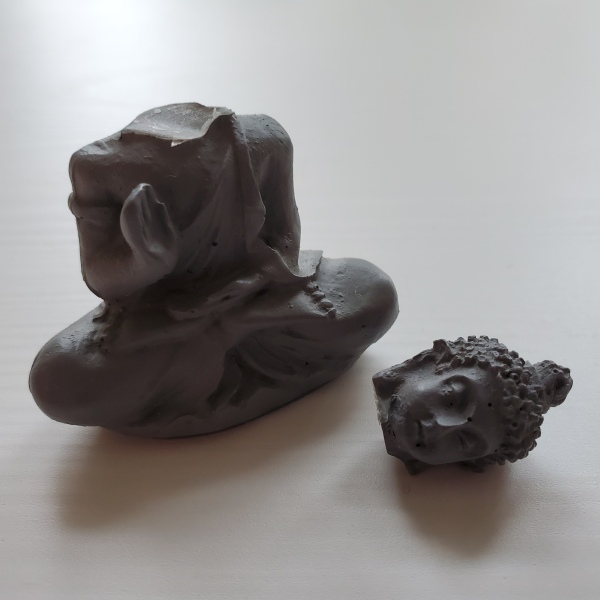
My Little Broken Buddha

20200126_161524.jpg

My best friend gave me a little figurine of a meditating Buddha. Its head was still on.

I meditate and I really like Buddhism. In a nutshell to me, it’s about letting go of our need for things to be just-so.

Our first big excursion to the mountains since my last concussion, a long road trip to the Canadian Rockies. . . . I was really nervous as we prepared to leave, because travel is my thing and mountains are my best friend’s happy place . . . but my concussion on our last adventure had done a number on me, and each month since then had felt hard, sad, gloomy–anything-but-adventurous.

So I brought my little Buddha along. To remind me not to hold on too tightly to my expectations for the trip. To help me know that it would be okay if everything didn’t end up being just-so. Its head was still on.

Things did NOT go just-so.

Morning, middle-of-nowhere, Saskatchewan, my adventure buddy’s wrist started hurting where a few days earlier she burned it on the stove. It started getting red and it became a small bump. By the end of the day it was a not-at-all-small bump, the entire arm too painful to use much. We checked into our Canmore hotel and after several frustrating calls to insurance we drove to the local emergency room where after a quick glance the doctor hooked her up to an IV for antibiotics.

Four visits to the emergency room in three days. Fevers, dizziness, red lines starting to spread, needles, blood draws, tubes installed in my best friend’s arm, a panicky midnight outing to find a thermometer interrupted by my phone ringing and my best friend telling me that she was now shaking so violently she could hardly hold onto anything.

Honestly, it was scary as hell. I think scarier for me than for her. It got a lot worse before it got better, and I knew that an infection going bad isn’t a thing you want to experience.

Just out of the woods, day two or three–the days became a blur of emergency room and hotel room–I hopped in the car to go pick up some groceries–completely drained of every kind of energy. I grabbed my little Buddha and held it in my palm as I drove, more for its vague feeling of comfort and familiarity than for anything else.

I hopped out of the car at the grocery store and tossed my little Buddha into the center console, and heard two things bouncing around. I picked it up. Its head was gone.

*feeling when your heart sinks but even sinkier*

I broke my little Buddha. :(

And then I sort of grinned. No sh**, may as well, everything else is broken. I guess it’s exactly appropriate that my little token of not-holding-on-too-tightly broke.

At first I thought about replacing it, but more and more it seemed perfect to me that it stay broken. Because now–every time I see it on my desk–I remember just how much holding on too tightly doesn’t work. That “broken” is only “broken” in the context of my need for things to be just-so.

In the 5th century BCE, a man named Siddhartha Gautama lived in what is now Nepal. His family was wealthy, but he was struck by the pain and suffering he saw in the world, so he tried being intentionally-poor instead. It didn’t “work” for him, so he embraced “the middle way”–a life of moderation: not desperately seeking ease and pleasure, but also not seeking pain and self-abasement. In all this practice, he learned a lot about life and then he taught the people around him a lot about life and then he became known as “The Buddha.”

“Dharma,” the teachings of The Buddha, have at their heart the “four noble truths.” Dukkha, Samudaya, Nirodha, and Magga. And the first three are why I love my little broken Buddha.

Dukkha: Suffering is a thing. It’s a part of life.

Samudaya: Why is suffering a thing? Because we think things are supposed to be just-so. We crave pleasure, we desperately try to control, and we hold on too tightly to what we think we want or need or love. Attachment.

“According to Buddhist psychology, most of our troubles stem from attachment to things that we mistakenly see as permanent.” ~ Dalai Lama

Nirodha: There is an antidote to suffering: Letting go of attachments, obsessive cravings, and desperate control, and living–not in a bitter past or an anxious future–but fully in the present, one day at a time. Acceptance.

What are you holding onto too tightly?

I still bring my little broken Buddha with me whenever I go out of town or when I have a big scary thing that I think needs to go just-so.

It’s a perfect reminder not to hold on too tightly.

Things break. Things hurt. Things fade.

Life is weird, and needing it to not be weird will only lead to frustration.

But life is also beautiful. And a strange and strong beauty and peace can be felt when you let go of your need for things to be just-so. . . . when you remember not to hold on too tightly.

~

“The root of suffering is attachment.” ~ The Buddha

20200126_161657.jpg

It always works out*

*Okay, life doesn’t always work out. Sometimes there’s just something truly tragic.

But I’d venture to say that 95% of the time we think that life has taken such a bad turn that things just won’t work out–we end up being wrong.

Try taking an inventory of your own experiences.

They usually worked out–didn’t they? Even 2019.

I think this is a very helpful thing to remember when it FEELS like everything is NOT going to be okay. It (almost :P) always works out. You’ve got this!

Here’s to your 2020–may it be full of experiences!

Pema Chodron - no one is ok but we get through just fine

If I could send a message to 18-year-old me

Do you ever imagine what you’d say to younger-you if you had the chance?

Life is really wonderful and beautiful and full of magic and excitement and love. But life is also weird for each one of us, sometimes a really tough kind of weird. The kind of weird that can make you feel lonely and misunderstood. The kind of weird that makes it hard to go to sleep sometimes, and when you do fall asleep gives you restless sleep and upsetting dreams. The kind of weird that can blindside you on what you thought was a good day and leave you questioning yourself and what you thought you had.

I think we all need help with these weird life-things. But sometimes the different paths you and I have walked, even just the fact that you’re not me, makes it really hard for you to find hope in my words, or me to find hope in yours.

Imagine that you got to talk to your younger self, though. And that your younger self could really listen, because you get them–you were them, are them.

What would you tell your younger self?

If I could talk to 18-year-old me, it might go something like this.

Hey buddy,

You are free.

You love people. You know people matter and you want to take care of their hearts. This is good. So good. You don’t matter less than other people, though. You need to accept that.

It is okay if some people don’t love you.

You are so much stronger than you think. You can speak up more boldly than you think, you can run harder than you think, and you can be a better friend than you think.

You are strong, but you are not superhuman. Don’t stoically or slavishly disregard your feelings and emotional needs. They’ll only get deeper.

It is okay if you want to dance. But it is also okay if you can’t dance because you’re feeling scared.

Not everything has to have a deeper meaning. You don’t have to always feel profound, always be growing, always be deep. Lots of good life is simple life.

A thing isn’t necessarily going to be better once you understand it. Knowledge isn’t always the answer.

There is SO much you don’t know. That’s okay. Let it stay that way, because it will anyway.

Feeling yucky does not necessarily mean you need to fix something. Some things will always, always, always feel yucky.

Sometimes you’ll even feel tremendously guilty for something you really can’t help, can’t fix. And rationally accepting that it is not your fault won’t stop the waves of guilt. You’ll still feel guilty.

When someone has broken your trust so much, or done you so much damage, that you cannot have a healthy relationship with them, it does not have to mean that they are a completely, irredeemably bad person. You have to learn to let someone be unhealthy-for-you without internalizing the lesson that people who make you feel hurt are inherently unsafe. Remember that when someone has hurt you too much, you don’t have to stay there to help the person who has hurt you come back from it. Sometimes a relationship needs to be over. But you have to let humans be just-humans in your mind. Or else humans will always feel too dangerous for you. And that will leave you very much alone.

There’s another reason you have to remember that even people who hurt you are still just humans. You’re going to hurt someone, too, someday. And if you learned to create your boundaries because the people who hurt you were somehow unworthy, or absolutely bad, then when you discover you also can hurt people, you’re going to feel like giving up all those boundaries you ever made. And that would be very bad. So remember from the beginning that people are just people, because if you create all your boundaries to keep out monsters, those boundaries might come crashing down when you realize people really are just people. And some of those boundaries needed to stay up. Not because there were monsters on the other side of them. Just because the real human on the other side of them was no longer healthy for you. Period. So learn early on to set boundaries just because your relationship with that other person is never going to be healthy for you, even while you see they’re just human.

Healing is going to take a long, long time, and it will be like peeling off the layers of an onion. Trust that process.

It is okay to be frustrated by someone else–that doesn’t mean you don’t love them.

Maybe you couldn’t hear that. Honestly, it really, really, really is okay to be mad. To be disappointed. Annoyed. It is okay to tell someone you don’t like something, that you’re unhappy. You need to express those things sometimes. You don’t have to do it in a mean way, but you do need to say how you really feel. If you don’t, things will get worse, not better.

When you screw up, you don’t have to earn back the right to be loved or to love yourself.

If you feel a desperate need for a thing to make you feel better, remember that there’s an underlying reason you don’t feel good, and until you deal with that underlying reason, you won’t really feel better.

If a thing has helped you make it through the tough times, even if you don’t think it’s healthy and don’t want to keep that thing as a part of who you are, try not to feel guilty about it or angry at yourself because of it. Appreciate what it has done for you. It helped you make it this far.

Let yourself not be okay. Having “problems” is okay.

You are not alone. The world is full of people who understand how you feel.

If you need a therapist, that’s not embarrassing, that’s okay. Therapy is good. For everybody.

“Nice” isn’t all it takes. Honest matters, too.

Don’t be afraid of bullies. They’re hurting people. Do something about it, even if it makes others uncomfortable.

Learn to say no. It isn’t just a thing-you-could-do. It is a skill, a tough skill, one you need to practice, and one that you desperately need to have. Learn how to say no to invitations. No to requests. No to others’ behavior. No to opportunities. Just say the Yeses you actually want to say.

There are lots of safe people in the world. Trust me, you’re going to find some of them and they are going to be amazing.

You will find some people who are safe and don’t want to hurt you or control you even when they are mad at you.

The amazing people in your life are going to have rough days, tough things, moods that don’t match yours. This is okay.

In any given moment, you are not responsible for the happiness of the person next to you.

You need friends. Real friends. More than one.

Even if it’s not normal, connect deeply with people.

Please don’t stop being a little weird. Nobody is normal and that’s what gives each person their unique beauty.

Do your own thing. Just because the world isn’t used to it doesn’t mean it’s bad. Elope. Change your name. Walk to work. Have slumber parties even though you’re an adult. Take drives for no reason. Skip college (without apologizing) or get seven degrees. Eat bell peppers whole like you’d eat an apple. Lay in the grass too long. Drive to the airport just to play the piano. If books and fresh air are your happy things, read a book while you’re taking a walk–even after a bartender says “Hey I recognize you, were you walking down the sidewalk reading a book?” Different isn’t bad. You are different, and you only have one life.

It is okay to do great things.

Don’t put off what you want to do until everyone is okay with it.

Don’t wait for permission to be epic, to do big things, to chase your dreams.

Ask for things.

It is okay to do “unimportant” things.

You don’t have to do the best thing. It is okay to let yourself really love and want something, no matter how insignificant you feel like it is.

Remember to look closely at the things around you, just to see them.

Remember that you will never live a “yesterday” or a “tomorrow.”

It is okay to be happy.

It is okay to be sad.

It is okay to be tired.

When you can’t know that all these things are okay, just breathe.

Sometimes you just need to be alone.

Sometimes you just need to call a friend, and honestly, they probably really want to be there for you.

Again, it is okay to have “problems.”

You don’t need to hide.

You have to let people love you. When someone gives you their love, let it happen. When someone praises you, let yourself smile really, really big. Feel it soak in. Unconditional love from someone who loves you won’t get through to you if you can’t unconditionally accept it. Only letting someone fill your tank when you’re filling their tank back isn’t safer. It will just make you feel a little more alone and unworthy.

Please, please let yourself get a good night’s sleep.

Music helps. You’ll get busy and distracted, so don’t forget about music.

Laugh so much.

Set aside times to think about life.

Take time to be quiet. Like, a lot.

Give more hugs and get more hugs.

brown sketchers, faded blue jeans, brown t-shirt

P.S. You’re 18. It’s okay if it takes you all your life to learn all these things. Lots of them might not make any sense right now. Lots of things I’m learning still aren’t making sense to me. You’ll always have a little bit of confused-kid in you. So if you don’t know what to think, that’s okay! You don’t need to “get it right.” I promise.

What does your letter look like?

Try writing it. I bet you find it therapeutic. I bet you find that it brings you feelings of compassion, feelings of peace with who you’ve been and where you’ve come. And I bet the stuff you needed to hear then, you still need to hear on some of the weird days now.

And you and I and all these other weird humans with weird life-things are a lot more alike than we tend to think. So I bet your letter helps me, too. I’d really love to read it.

We’re all in this together.

Blogging 101: 3 Do’s & Don’ts

“Ouch…”

The ominous title to one of my first ever blog posts.

“Tried to barehand a flyball today. Worst case scenario: Root canal.”

Another gem from 14-year-old-blogger-me:

“Does anybody want to buy me a package of two-hundred fifty-three thousand four-hundred and twenty-nine glow in the dark frisbee’s? I’d be much obliged. I can’t even begin to describe how much I would love that many glow-frisbees!”

You’re welcome, World, for sharing the dorky ambitions and random words of wisdom that only a 14-year-old could share. A few nights ago, I stumbled upon my oooold blog, hidden in the nether regions of the internet. I promise you, you will never find it. Thank God.


I’ve been blogging since I was a kid. Unfortunately.

On a more serious note, I’ve been writing on this blog for the last several years and have taken blogging seriously as a skill worth learning as well as I can. I write about anything and everything I’ve learned–at work, in my personal life, about communication, about motivation–anything that may be of a little help to someone else walking their own path in this journey we call life.

I’ve grown to really appreciate blogging and to wish that more people would try it. I see two big reasons for people to blog:


For other people.

Sure, there’s already a lot of noise out there. So many blogs, articles, opinions. Why would you want to add to it?

The truth is, you really don’t know who your unique way of seeing and saying things may help.

You have had a rich life full of all kinds of experiences, good and bad. You’ve learned from things you’ve seen, heard, and done. You have a lot more wisdom to share than you may think. And every day, others are muddling their way through the same complicated, confusing, challenging life things you have. Or maybe it’s not as deep as all that. Maybe somebody just needs help deciding which new pair of hiking shoes to buy. Can you help with that?

And even if these people find someone else who has learned the same lessons you have and has put it down in words for them, maybe those words weren’t spoken in the unique way that would resonate. Maybe that writer’s perspective isn’t quite what these people need. Maybe your unique experiences and emotions are what will make those lessons click for some.

And even if these people have already found an answer to their questions that resonated–even if they already know–they may still need to hear the lesson said again and again and again and again and again. We’re strange creatures. Sometimes we need to hear what we already know to remember it. Sometimes we just need a little inspiration.

“Everything has been said before, but since nobody listens we have to keep going back and beginning all over again.” – Andre Gide

So don’t be afraid to increase the volume of kind, positive wisdom in this world. We’re all in this together.


For yourself.

I think the writer may get more out of the practice of blogging than any reader ever will.

Writing–especially what’s deep in your heart–is an incredibly freeing and therapeutic experience. Try it and see for yourself.

As you put down in words the things you feel deeply and believe deeply, what you care passionately about and what you desire, and the ideas you most want to help others find–as you put these down in words, your thoughts become clearer, your convictions become stronger, and your ideas become more concrete. The practice of thinking and talking through something analytically, searching for the right language to use, is incredibly educational and thought-provoking. Writing is one of the best ways to learn.

And then, after you’ve written for a few years–after you’ve written to help others, written to feel freedom and healing, written to gain clarity and understanding–you look back and realize that your blog is really a journal as much as it is anything. How rewarding to look back and see how your thoughts and cares have developed over time with the turns your life has taken! And best of all, every now and then you will stumble across some of your own words of wisdom: Words you had forgotten, but that you desperately needed to remember on this exact day.

Bonus benefit: If you’re ever in a situation where there’s a need or an opportunity for someone to give a last minute presentation of any nature–inspirational, instructional, etc–having tons of your own prepared presentations at your fingertips is a lifesaver!


So why don’t you try blogging?

If you were to give blogging a go, what would you write about? What lessons have you learned in the last year? What do you care most deeply about in life? What have you struggled with? What has made you ecstatically happy?

If you’re ready, there are plenty of places to get started easily and without paying a cent. I use wordpress.com. You can create a blog free and start writing. And if you’re feeling nervous, they’ll let you hide your blog so you can give it a shot without any prying eyes.

What if you don’t know what to write about? What your big message will be? What your topic of expertise will be? That’s okay. Just write what you’re thinking about today, what you learned this year, what you want next year, and what you believe most strongly. What do you wish you could help the world to know? Just start writing. Or maybe write about your hiking shoes.


When you’re ready to give blogging a try, here are 3 Do’s and 3 Don’ts that I’ve learned (the hard way) in my experience as a blogger. Let’s start with what not to do.


DON’T . . .

. . . try to blog perfectly.

You never will. If you wait till you can do it perfectly, you’ll never publish a single post. Besides, sometimes you’ll think you’ve written your best piece and it won’t resonate with anyone. And then you’ll write one you just think is weak and poorly written, and you’ll be surprised to discover it spoke deeply to lots of readers. Your “best” will sometimes be your worst, and your “worst” will often be your best. So don’t try to blog perfectly.

. . . try to keep everyone happy.

You can’t. You have so many strong, genuine, deeply caring messages inside of you to give. So many ideas and experiences that could help others. But every one of those messages is going to piss someone off. It’s okay. You have to be okay with it. If you try to keep everyone happy, you’ll water down everything you write until your words don’t help anybody. (And then someone will still be displeased with you for being a people-pleaser.)

. . . be embarrassed.

Eventually, you’ll look back at a post you wrote a long time ago and you won’t like it. Your face will go beet-red, like mine always does. You’ll cringe and shake your head and panic a little. “I can’t believe I shared this with the world! This is awful! What was I thinking?” And then you’ll realize that everything is okay and that life went on. That’s a good moment to experience.


DO . . .

. . . write from your heart.

I know this is so cliche. But I think it’s the strongest and best advice anyone can possibly give. Even if it’s not blogging–maybe you’re a writer, a speaker, a leader, or an influencer of any kind. Be genuine! People can tell. And when you truly speak your honest and passionate message from deep down inside of you, that will connect with people.

. . . promote yourself.

It’s as simple as this: If you want to talk to people, tell them. Let the world know you’re hear to say something. It just might listen. There’s no shame in asking to be heard.

. . . keep writing.

You’ll probably feel like a fraud. It’s a thing. Whether you’re an occasional writer, a hobby blogger, or you make a career of it–you’ll feel like you’re not good enough, not committed enough, and that people won’t take you seriously. Especially early on. You’ll feel self-conscious as you look at how little you’ve done. You’ll feel embarrassed that you only post once or twice a month, that it’s sporadic, or that you’ve lost touch with it for a time. That’s okay. Write another post. And then another. Just keep writing. Baby steps. It’s amazing how a few pieces written here and there add up over several years. Suddenly you’ll turn around and see behind you a hundred posts you’ve written. Words that may have helped countless people along the way and may still help others. Words that have helped you already and will help you again. Just keep writing.


Neil Gaiman, one of my favorite writers, said this. And it’s one of my favorite things ever said about being a creator. Whether you blog, write, speak, record a podcast, whatever you do…

“The one thing that you have that nobody else has is you. Your voice, your mind, your story, your vision. So write and draw and build and play and dance and live as only you can.” – Neil Gaiman

I hope you share your message with the world. Blogging may be just the way to do it. What do you think? Will you give blogging a try?

If you already are, good luck and keep up the good work! :)


I recently presented this material as a Toastmasters speech entitled Blogging 101. At the end of it, I held a Q&A session to further the discussion about what blogging looks like–for me and for others. A few of the questions prompted some great conversation. I’m sharing them here in case it helps.

Q: Is there anything you WON’T write or post about publicly? Anything you wouldn’t want people from work to see? Anything that’s too personal?
A: Not much anymore. There used to be a lot. And then I learned the lesson that a very wise friend of mine once put into words: “People connect at the level of their struggles.” We’re all in this together. If anything, I’m happy to help everyone see that being real is okay.

Q: CAN you decide who gets to see what you write? Can you keep certain people from seeing it?
A: Yes. You can make a blog totally private, so that nobody but you can access it. You can share it with a few certain people so that only they can access it. You can change its search settings such that it’s easy to share but people won’t find it just by searching the internet. Some people who make money by writing valuable content will have their blog set up so that only people who have paid for subscriptions or who have used another related program can access the blog. All kinds of options!

Q: With so many opinions out there, how can you trust that the information you’re getting from a blog is accurate? Like someone’s review of a product?
A: Great question! First of all, there’s no guarantee. You use your best judgment. But a couple helpful ideas: First, if you’re looking for specific information, like feedback or tips on traveling to a certain destination or on which product to buy, does the review or blog you’re reading seem to match the feedback of others? If almost everyone agrees, that tells you something. Second, one of the advantages to blogs is that they’re typically independent. Sure, some bloggers are being paid by the company whose product or service they’re recommending. Generally, they’ll have to disclose this somewhere. But you’ll also find lots of independent third party bloggers who are just writing their own real experiences. If anything, these are more helpful than advertisements and biased info you’ll get on a company’s own website.

Q: Can you blog under a pen name?
A: Yes! Absolutely! You can do that forever, or you can do it to help you get started if you’re nervous.

I’d love to know your answers to these questions! And I’d love to hear if there are any other questions or thoughts you’d like to share.


If you are a writer, or are interested in writing, or just like reading about writing, check out My 100th Blog Post: A Few Thoughts About Writing.

Neil Gaiman - As Only You Can