7 Words of Hope from a Nazi Death Camp

One of the hardest books to read, but one of the most rewarding. I just finished psychiatrist Viktor Frankl’s book Man’s Search for Meaning. During the Holocaust, which claimed the lives of an estimated 17 million humans like you and me, Frankl was moved from camp to camp, doing forced labor in brutal conditions, threatened constantly with death. Man’s Search for Meaning serves both as a memoir of sorts for his time in concentration and labor camps and as an explanation of how that experience shaped his understanding of psychology.

I want to share with you just a few of the words of hope that I found in Frankl’s book, and I hope you’ll be inspired to read the rest of the book yourself. I can’t state strongly enough the impact that this book has had. No matter how sad its stories, I found it to be one of the most hopeful books I’ve read.

1. You matter.

Some days you may question whether there’s any point to your being here. But even in the worst of times, Frankl found that if he and his fellow prisoners considered the impact they might still have on others through their love and their work in the future, they could see just how much each of them did matter.

“A man who becomes conscious of the responsibility he bears toward a human being who affectionately waits for him, or to an unfinished work, will never be able to throw away his life. He knows the ‘why’ for his existence, and will be able to bear almost any ‘how.'” – Viktor Frankl

2. You get to choose your life’s meaning.

Life is a weird path of twists and turns for each of us, and in comparing ourselves to others or to the ideals we think we’ve learned, we sometimes can’t find how we matter. But Frankl learned that peace can be found in giving up the search for an ultimate meaning, and instead choosing what you will live for.

“Everyone has is own specific vocation or mission in life to carry out a concrete assignment which demands fulfillment. Therein he cannot be replaced, nor can his life be repeated. Thus, everyone’s task is as unique as is his specific opportunity to implement it. . . . Ultimately, man should not ask what the meaning of his life is, but rather he must recognize that it is he who is asked.” – Viktor Frankl

3. You can always find joy and fulfillment in LOVE.

Love is a powerful and beautiful thing. For me, this was one of the most meaningful and helpful messages in the book. In a strongly individualistic society, it is hard to grasp the significance and fulfillment in just loving another person. It is okay to live for love.

“My mind clung to my wife’s image, imagining it with an uncanny acuteness. I heard her answering me, saw her smile, her frank and encouraging look. Real or not, her look was then more luminous than the sun which was beginning to rise. . . . A thought transfixed me: for the first time in my life I saw the truth as it is set into song by so many poets, proclaimed as the final wisdom by so many thinkers. The truth–that love is the ultimate and the highest goal to which man can aspire. Then I grasped the meaning of the greatest secret that human poetry and human thought and belief have to impart: The salvation of man is through love and in love. I understood how a man who has nothing left in this world still may know bliss, be it only for a brief moment, in the contemplation of his beloved.” – Viktor Frankl

4. You can reduce your suffering by observing it objectively. 

It’s hard to imagine suffering worse than prisoners in a concentration camp, but even in such intense suffering, Frankl found relief. He discovered that a simple change in how you observe the present moment can make a bad situation much more bearable. He told a story about when, during a particularly awful day, he started imagining that he was actually retelling his situation in a future psychological lecture. Just this simple mental exercise helped immensely, reminding him that life was bigger than his current hurt, that the present was simply a circumstance that could be observed.

“By this method I succeeded somehow in rising above the situation, above the sufferings of the moment, and I observed them as if they were already of the past. Both I and my troubles became the object of an interesting psychoscientific study undertaken by myself. . . . What does Spinoza say . . . ‘Emotion, which is suffering, ceases to be suffering as soon as we form a clear and precise picture of it.'” – Viktor Frankl

5. Feelings of joy and suffering are relative. You’re not stuck in your feelings.

This may be a blessing and a curse, depending on how you look at it and what focus you choose. Frankl observed that the feelings of despair, suffering, frustration, and sadness, weren’t necessarily worse or more overwhelming, in a situation as awful as a concentration camp, than in a less severe circumstance. Humans tend to feel suffering very completely, whether the stressor is big or little. On the one hand, that can mean a small disappointment can be overwhelming. On the other hand, that can mean that you may handle the very worst circumstances much better than you think–which is a hopeful thought. Studies have shown that people who go through awful events often end up much less devastated, at least after a while, than they think they will be. In the same token, feelings of happiness and joy can be extremely strong, even when found in very simple experiences.

“Thus suffering completely fills the human soul and conscious mind, no matter whether the suffering is great or little. Therefore the ‘size’ of human suffering is absolutely relative. It also follows that a very trifling thing can cause the greatest of joys.” – Viktor Frankl

6. Growing old is going to be okay.

This one sucks. I always hate thinking of growing old, watching my remaining time in this life get shorter and shorter. This book honestly helped with that. Frankl has the most beautiful perspective on this that I’ve heard. It’s a peaceful and hopeful one. I’ll let him speak for himself. I hope it helps you as much as it helped me.

“At any moment, man must decide, for better or for worse, what will be the monument of his existence. . . . I should say having been is the surest kind of being. . . . The pessimist resembles a man who observes with fear and sadness that his wall calendar, from which he daily tears a sheet, grows thinner with each passing day. On the other hand, the person who attacks the problems of life actively is like a man who removes each successive leaf from his calendar and files it neatly and carefully away with its predecessors, after first having jotted down a few diary notes on the back. He can reflect with pride and joy on all the richness set down in these notes, on all the life he has already lived to the fullest. What will it matter to him if he notices that he is growing old? Has he any reason to envy the young people whom he sees, or wax nostalgic over his own lost youth? What reasons has he to envy a younger person? For the possibilities that a young person has, the future which is in store for him? ‘No, thank you,’ he will think. ‘Instead of possibilities, I have realities in my past, not only the reality of work done and of love loved, but of sufferings bravely suffered. These sufferings are even the things of which I am most proud, though these are things which cannot inspire envy.'” – Viktor Frankl

7. You are always free to choose and change.

Another one that is near and dear to my heart, that inspires compassion and hope for myself and for others: His life in Nazi death camps persuaded Frankl that people are not stuck being, thinking, speaking, or acting as they have, or as they’re conditioned to. Sure, the deck may be stacked against you. And on average, people tend to stick with their patterns. But at the end of the day, each of us is free to choose. Free to choose how we will react to the circumstances life brings to us. Free to choose who we are.

“Man is not fully conditioned and determined but rather determines himself whether he gives in to conditions or stands up to them. In other words, man is ultimately self-determining. Man does not simply exist but always decides what his existence will be, what he will become in the next moment. By the same token, every human being has the freedom to change at any instant. . . . one of the main features of human existence is the capacity to rise above such conditions, to grow beyond them. Man is capable of changing the world for the better if possible, and of changing himself for the better if necessary.” – Viktor Frankl

Guys, it’s hard to communicate how much I loved this book. It wasn’t the most impressively written, it wasn’t the most exciting, it wasn’t the most pleasant. But it was full of the raw experiences of real life in all its nitty gritty weirdness. It was honest. And it was full of hope and inspiration. So full of hope. Real hope.

I hope you’ll read it. And I hope that every day for the rest of your life, you’ll find hope.

~

“Everything can be taken from a man but one thing: the last of the human freedoms–to choose one’s attitude in any given set of circumstances, to choose one’s own way.” – Viktor Frankl

Are you really seeing them?

“Look at other people and ask yourself if you are really seeing them or just your thoughts about them.” – Jon Kabat-Zinn

Have you ever found yourself looking back at old memories–photos, messages, etc–and realizing that your opinion now of an old friend is entirely different than it used to be? For example, I used to have very conservative (and vocal) opinions about how people should look and talk. I always judged the “rebellious” kids I knew, felt disappointed and hopeless for them. Looking back now at the those same kids, I see who they were as very normal and healthy and in fact think I should have been a little more like them.

Our minds change from time to time. Enough that we should be able to remember that the way we see someone right now may not be accurate.


It can be helpful to spend some time thinking about what determines how we see people. There are a lot of things that silently, sneakily influence our interpretations of others:

  • What we expect to see. As John Lubbock said, “What we see depends mainly on what we look for.” When you start with assumptions about someone, you tend to see what confirms your assumptions. It’s called “confirmation bias.”
  • What we’re already focused on. Always focus on the bad in someone, and that starts to be all you see. Always see the good only, and you can be blind to problems. Have you ever bought a car and then immediately started seeing way more of those models than you used to?
  • What we’re afraid of. How have you been burned in the past? How have people hurt you or let you down? Did you get cheated on? Then you see that in others. Did someone stab you in the back when they should have been supporting you? Than you stay on the lookout for the first signs of that in others.
  • What we are hoping for. Do you ever see people through the lenses of what you’re hoping for? What you need? Looking for friends who will accept you? Looking for a special someone to selflessly love you? You can want something bad enough that you might see it when it’s not really there.
  • What we plan to do about it. One of the biggest and most powerful influences on how we see others is our own intention to react and deal with things. Stephen Covey said it best: “Most people do not listen with the intent to understand; they listen with the intent to reply.” Who might that other person be separated from how we think we should relate to them?


Have you ever realized somebody is not who you thought they were? Maybe someone you always thought was mean, or someone you thought was nice. Have you ever been on the opposite side? Feeling like someone is assigning an identity or motives to you that just aren’t you?

Assuming and prejudging leaves both sides hurting and confused.

On the other hand, opening your mind and seeing someone for who they really are and what they really say–not what you expect or judge about them–can open your eyes and heart to another amazing human. And honoring someone for who they really are can make you an empowering part of their life, too.

Jon-Kabat Zinn - Really seeing people

If another human can…

I’d like to be a professional writer and public speaker who helps make the world a better place. BUT. I’m SCARED.

I’m scared that I don’t have what it takes. So I often find myself giving up. I hold myself back. Out of fear.

Do you ever find you’re not trying because you don’t want to fail? Turning your back on your dreams because you probably couldn’t bring them to life?


I often find myself wondering in amazement about grand things that other people have done: How the hell did they get somebody all the way up to the moon??? How does one person handle as much responsibility and stress as a country’s leader or a giant company’s CEO? How did my friend ever get so successful at sales? And what the hell even is the internet and how can it possibly work?!?

Sometimes other people seem superhuman. Sometimes the advancements and accomplishments that make up the world I live in seem like magic.

Who are these god-like people who shake the world? The inventors, the leaders, the athletes, and the entrepreneurs? What other-worldly stuff are they made of?


Turns out they’re just humans.

Like you and me. Made of the same stuff. They were born with the same senses and tools and brains as I was.

Sometimes I have to slap myself awake as I watch successful business-people who make hundreds of thousands a year. I so often find myself feeling small and weak and full of doubt. If only–if only I had what they had.

The other day I was having a heart to heart with someone way higher up than me on the ladder. She was describing to me how she sometimes struggles with communicating freely because she’s been burned so many times. Then it hit me–here’s this person in a position I tell myself I couldn’t handle yet or don’t deserve. And she has the exact same insecurities as me. But she’s made it that far and is doing great at it. Humanness and all.

Turns out I can do those things, too.

It stands to reason. We’re all humans. I’m fully capable of making the same decisions and speaking the same words as any CEO or world leader. We’re all human, with the same voices to persuade with and the same minds to decide with. I could be that executive that executive I hopelessly compare myself to when he walks by my desk. I have to stop telling myself that I can’t.


Yes, some start with an advantage. Some are born into healthy homes with supportive parents. Some get good educations and college degrees. Some are born into wealth. Some grow up surrounded by safety nets others don’t have, safety nets that help them take those big leaps.

But there are a lot of people who have started with huge disadvantages and still achieved their dreams against all odds.

One of my heroes as a baseball fan, Mariano Rivera, grew up in a poor Panama town using a cardboard milk carton as baseball glove and a tree branch as a bat. He accepted early on that he was born to catch sardines on a commercial fishing boat. Despite a deck stacked against him–poverty, discouragements, injuries, and broken dreams, he ended up achieving such wild success in baseball that he is now widely considered the greatest closing pitcher of all time.

And it’s never too late to start! Ray Kroc was a milkshake device salesman until he bought McDonald’s as a 52-year-old. Vera Wang didn’t start her designing career until she was 40. Colonel Sanders bounced from job to job until he finally founded KFC at age 62. And Harrison Ford was so disappointed in his weak attempts at becoming a Hollywood star that he became a carpenter instead to support his family–until he became Han Solo.


Point is–you’re no different. You’re a human. In general, you have the same abilities as the next person. The same potential. None of those massively successful people are super-human. You don’t have to be super-human. I don’t have to be super-human.

You can do it–just the way you are! You’re a person. If someone else can do person things, so can you.


I’ve experienced this time and time again in my own life. It’s encouraging to look back…

a1 - runningI took my little brother running one night that I’ll always remember. “I promise,” I told him, “if you just don’t stop, no matter how tired you feel, once we’ve made it about 2 miles you’ll feel so much better!” And it was true. A block in, he could hardly put one foot in front of the other. But he kept going and finally hit his stride. I have found that almost anyone can be a runner. And most of the people who “can’t” really can. They’ve just already given up.

a2 - guacamoleWhen I started my first job as a 19-year-old, I was absolutely terrified and clueless. I crawled into bed in tears night after night feeling like I was weird and awkward and would never fit in, never make it. But then I did. Before long I was getting promotion after promotion and found myself running my own store. And fixing up a mean batch of guacamole.


When we got engaged, Lyssi and I had this crazy dream–what if we went and got married in Italy? But we put the thought away. We’re not THOSE people! We can’t do that! Then one day we started trying–just for kicks. A few months later we were exchanging vows together at the Villa del Balbianello, living our dream. Turns out, we ARE those people!

a3 - wedding

Another big one that I think about a lot is the lifestyle my wife and I have embraced–full of exploring and adventuring, taking planes, trains, and automobiles everywhere we can to experience a world full of beauty together. I always hear people envying those people that have the time and the money to explore and travel all the time. Well I’ll let you in on a little secret. We don’t have more time and money to travel with than the next person. In fact, for a long, long time we dreamed and dreamed that one day we’d be able to go on those adventures–like “those” people. And then finally we decided to stop waiting and figure out how to make it work. Only then did we discover just how much we really could do. (If you want any adventuring tips, let me know. It’s something we’re passionate about!)

a4

(Fyi, each of the above pictures came from trips there were good adulty reasons not to take.)


So please–please, please, please–don’t tell yourself you can’t. Don’t tell yourself you’re “not that person.” Don’t give up before you’ve started.


Lately I find myself daydreaming about the next big thing I’m going to discover I can do. Maybe perform piano. Maybe take writing to the next level. I could go back and finish my degree. Pursue another big promotion. Or what the heck, maybe I’ll go back and try baseball again.

If there’s something you want, don’t be afraid. Go for it. Embrace it. Know that it could be you. Know that the people already doing it are just like you.

What’s next for you?

~


“All our dreams can come true–if we have the courage to pursue them.” – Walt Disney

What is inspiring you this Christmas?

This Christmas I’m thinking a lot about what inspires me. I know a new year is right around the corner. Life is so short, and I want the next year to be just as full of adventure as this one has been. But twice as bold and free.

What do I feel passionate about at this point in my life? What has been meaningful about the last year? And what do I want out of the next year?

A few things come to mind…


Looking back at this year I wish that I had helped people more. So I find myself inspired to do more of that in the next year.

I have a friend who recently ran into some homeless people and after chatting for a bit went home and picked up her dinner in the crock pot and brought it back to share with them. I want to be like her when I grow up.

People all share the same humanity deep, deep down, and there are others just like me all around who don’t have what I have. There’s a lot of help needed in this big, messy world. And I want to do that any way I can. I wish I were an expert at answering where to go to help, who to give to, what organizations to volunteer with. I’m not, yet. But I know a few people who are, and I think the world of those people.

This next year I want to be as compassionate as I can be. My best friend tells me that to her, compassion means really seeing people. Not just the easy, surface, first-impression version. Stephen Covey talks about the widespread habit of listening to people through your own auto-biographical filter. What do I think of them? How might they affect me? What should I say to them now? When you see someone trying to work out at the gym, clearly their first time–or run into a mom at the grocery store who can’t seem to control her kids–what story are you telling yourself about them? What stereotypes do you impose on people when you meet them? What motives and purpose do you assign to the people in your life?

Do I ever stop to ask who someone really is underneath what I’ve decided about them? Do I ever make an effort to really understand someone–to really get to know why they are who they are? Do I listen to what they want me to hear about them, see what they wish I could see about them?

I want to see people through the eyes of compassion this year–to see the very best in people and to be honest with myself about how much more there is to everyone in their own joys and struggles than I could ever guess. I want to honor the real person inside of you, even though that means admitting that in all my wisdom and self-confidence, I don’t really know you and can’t be your judge.


The most inspiring times this last year were times spent in the incredibly beauty of nature. From the still, quiet swamp ten minutes down the road to the mountains of Utah and Nevada. From the Neskowin ghost forest off the coast of Oregon to the beautiful creeks flowing through the Smoky Mountains. We all get to share the gift of a world full of the kind of beauty that leaves you speechless and breathless. Taking the time to go out and look, listen, and feel nature must be one of the healthiest and happiest things you can ever do.

“In every walk with nature one receives far more than he seeks.” – John Muir


And in doing and experiencing more of all these things that inspire me, I want to do them more freely, more boldly, and more unapologetically than I ever have before.
I want to live more by the words of my friend, Glenn: “What would you do if you were not afraid?”


What inspires you? What happiness and meaning will you find before the next Christmas?

Merry Christmas!

inspire

Everybody is bad at something

Everybody is bad at something.

I’m really bad at handyman stuff. I don’t know how to fix things or maintain things. Whenever something goes wrong with my car, or something breaks in the house, I feel totally lost. I feel overwhelmed when I have to take care of it. Like I’m out of my depth. I’m always afraid I’ll break it worse. Even if I take my car to the shop, or have someone come do the work for me at home, I feel embarrassed that I have no idea what I’m talking about. I never know if I’m getting ripped off by someone who’s realized they’re dealing with a guy who doesn’t know the difference between an alternator and a radiator.

It’s one of the things I’m bad at. There are lots of things I’m bad at. There are a few big important things that I’m especially bad at and feel very insecure about or even ashamed about. Those big ones I think about a lot.

Do you ever get stuck seeing yourself and your life exclusively through the lens of that one big thing you’re bad at?


A while ago I was chatting with a young couple about their big thing: Credit card debt. They were feeling very defeated. Sad, scared, embarrassed, and most of all hopeless. They could have more than paid for a mortgage with their minimum monthly credit card payments. They were searching for options to pay it down quickly and avoid thousands upon thousands in interest payments for years and years, but so far everything had been a dead end. They said they thought about it all the time, and it was constantly weighing them down. It was starting to define their lives.

But this young couple was the sweetest couple you could meet. Their careers were off to a great start. They were stylish and funny. They clearly had the greatest friendship and partnership. In most ways, they were the couple everyone wants to be. All they could see, though, was their debt.

And sometimes all I can see are the things I’ve failed at or the things I’m bad at.


I think we forget sometimes–very often in fact–that there is so much more to life than the one big thing we’re bad at. So we’re insecure.


Maybe someone has massive debt that they can’t see past, always stressing them out. But maybe that same person has a fantastic career going, one they should be very proud of, and if they focused on that they’d feel confidence and hope.

Maybe someone else without much of a career–still delivering pizzas or washing dishes–maybe that someone is looking enviously and insecurely at that first person with the great career, thinking that if only they were so successful, they’d be happy. But maybe the delivery guy is also fit and athletic, playing sports with friends all summer, hitting the gym every night.

Someone else is watching the athletic guy, wishing they looked like him–that they weren’t overweight, wishing they could go running, or at least climb the stairs without feeling short of breath. They focus on their weight problem until it seems like the only thing in their life. But they’re forgetting they have a couple hard-earned degrees from prestigious universities–an education many people only dream of. They’re smart and well-read. They have a great understanding of politics and current events. They have ‘Harvard’ on their resume and an almost automatic leg up on their professional competition.

And there’s another person who can think of nothing but how badly he wants and needs that education. If only he had taken out the loans to go to school, life would be so much better now. He constantly regrets it and feels inferior to his professional peers. He dreads getting asked where he went to school. But maybe he’s taking for granted what a great family he has. He has a couple kiddos that think the world of him. He gets to come home every night to warm hugs and smiles. And maybe in reality, that can make him a lot happier than a degree.

And maybe there’s someone else who doesn’t have a family. She doesn’t fit in with her siblings and she isn’t respected by her parents. She’s had to move on, and she’s lonely. She sees happy families everywhere and it hurts her. But what if she chose to focus on what she’s good at–the great things in her life? Maybe she gets to go on adventures, exploring the great outdoors, traveling to beautiful cities and exotic mountains.


The point is this: There’s always a hole in someone’s heart. There’s always a big thing someone’s bad at. Something they don’t have. Their big insecurity. But that’s never all there is to them.


What’s the thing you’re bad at? What’s the sad thing in your life? What’s your big insecurity?

If you find yourself thinking about it constantly, defining yourself by your weakness–you’re not alone. So many of us naturally focus on the sad or bad thing about ourselves.

But there’s also always good stuff. Good stuff we may not be seeing, because we’re so distracted by the bad stuff.

When you’re feeling discouraged about who you’re not, try thinking about who you are instead. There’s amazing stuff there.

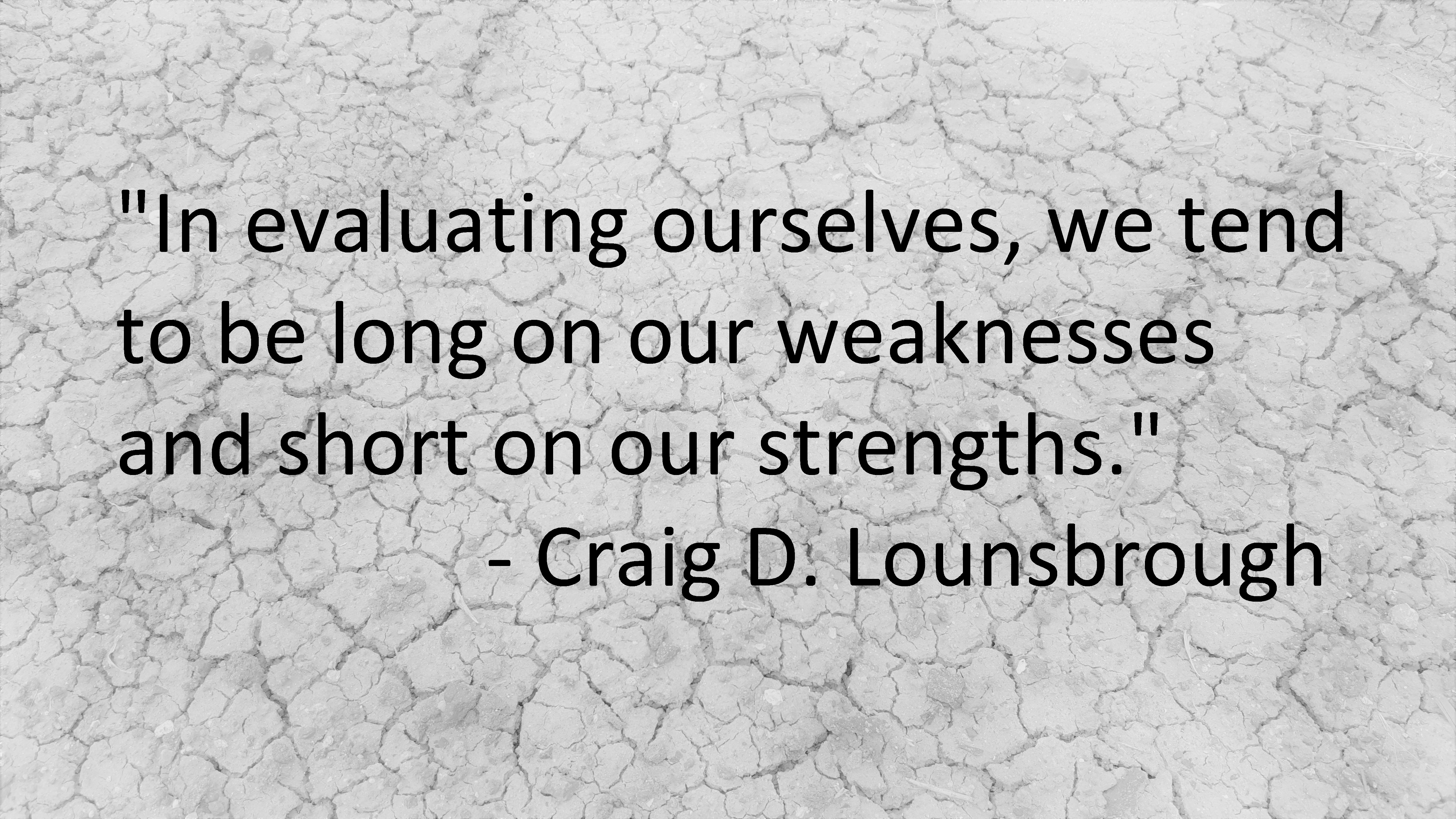
Craig Lounsbrough - We focus more on our weaknesses