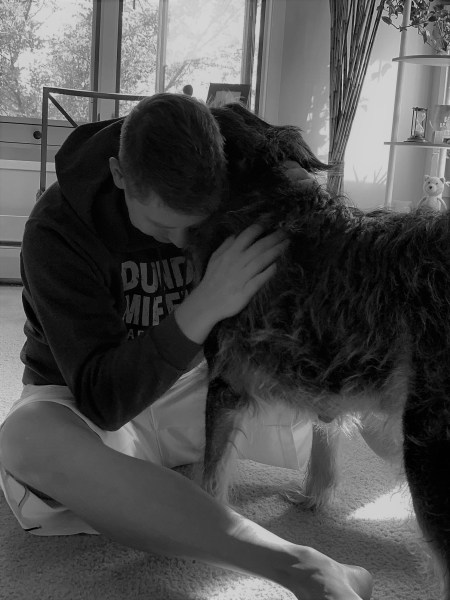
Letting the waves do their thing

Think back. Remember vulnerable-you. At your weakest, your most drained, your most crushed.

What did it?

“Trauma” is a universal experience. Your life may not have been dominated by it, but you’ve had your days.

Younger me found refuge in my bedroom closet. I’d spend hours in there. It felt a little safer.

Have you ever heard yourself say “I just want to hide under a rock” or “I just want to crawl under my blanket and never come out”?

What drove those big yucky feelings way back when you felt them and learned to fear them?

And–and here’s the fun part–do you ever still relive them now?

What brings you suddenly and helplessly back?

It’s human to have triggers.

Reliving trauma can turn the strongest person to mush. Sometimes with little warning.

And here’s the difficult part, but maybe the hopeful part . . .

What do you do when that happens?

When it hits you like a ton of bricks.

When you’re thrown right back into the saddest and most helpless feelings.

When you’re 12-years-old again getting screamed at or hit again.

When you’re suddenly friendless and unwantable again.

When someone’s looking at you that yucky way again.

When you hear that voice again that you really, really needed to never hear again.

When you have that old nightmare again.

When everything feels dangerous again.

When you need to go hide in your closet again.

What then?

I think sometimes we try to say, “I beat this then, I can beat this now.” And we get tough. Flex our I-don’t-cry muscles. Manufacture positivity.

And yes, there is some hope in a soft and encouraging reminder, “I made it through this before.”

But I don’t think the tough way through works in those darkest times.

Surfing is used frequently as an analogy for the ups and downs of life. When the waves come, you ride them, right?

But surfers also have to learn a life-saving lesson: When the water is too strong, trying to pull you under and away–which, absolutely, 100% it will be sometimes–you cannot fight it.

When the current is too strong, fighting against it will kill you.

You have to acknowledge and allow the power of water.

It is too strong to beat.

And when you stop fighting, embrace the overwhelming power of the water, let it do its massive thing with you, and even swim with it (or at least sort-of-with-it–like not against it) . . . it eventually spits you out into safety.

And I think life is the same way.

Like a sunny day on the beach, life is beautiful.

And like the surfing analogy goes, we can learn to ride its waves.

But when you wipe out (and you will), and find that the waves are just too damn big today (and you will), and that they’re pulling you down into the darkest darkness (and they will)–the only way out is through.

So what would happen if, when the trauma suddenly shows back up with a vengeance, and you’re suddenly a powerless, paralyzed kid again . . . what would happen if you just let the waves crash over you, let the overwhelming power of grief or fear or anger do its thing?

What if you stopped struggling, stopped denying, stopped “at-least”-ing, stopped numbing . . . and just fully accepted the overwhelming, crushing force of deep trauma?

Maybe you’d stop living in a cycle of exhaustion, fighting to keep your head above an angry ocean surface.

Maybe all the feelings would wash over you, envelop you, and fill you up.

And then, like a current in the sea, they could carry you through the darkness back to safety.

Emotions are designed to be felt.

Not fought.

Grief.

Fear.

Anger.

When fought, they will win. They’ll hold you down.

When acknowledged as overwhelmingly powerful . . . they’re “designed” to spit you out on the other side.

A psychologist friend of mine shares that a lot of his clients try desperately to run the other way when deep sadness shows up, distracting themselves, denying their feelings, and even avoiding big, beautiful life things so that reminders won’t trigger sadness again. They explain to him that they’re afraid if they let themselves feel the sadness all the way, it will never stop. It will be too powerful. It will crush them and hold them under for the rest of their lives. And he gets to give them a shot of hope that he’s learned as a professional who studies the human mind: No. It won’t. It will feel AWFUL. And then, once it’s done its thing, it will recede.

When old trauma and grief show up, do you get stuck in a cycle of “not listening, not listening” with your fingers plugging your ears, as if somehow, as long as you don’t cry, it will get better?

It doesn’t, does it?

What if you just let the feelings do what they’re designed to do?

Maybe you even go hide in your closet again and sob for a while, like when you were 15.

Then maybe, once its done its thing, it will let you back up for air, and you’ll see that the sun is shining.

And yes, the same wave will pull you under again sometime. But it doesn’t own you. You will come back up for air and surf the beautiful ocean of life again.

This WEIRD holiday season

Humans infect each other through smiles and embraces.

“Cheer” is a word about the holidays.

And Cheer is just the greatest condition to be infected with.

Each year, sometime in October or November, we hear rumblings of Christmas music.

Cheer is on its way.

Soon we start putting parties and get-togethers on the calendar.

We browse to find the perfect gifts, picturing the glow we will see in the eyes of our best buddies as they tear into the wrapping paper.

Daydreams of pies and cinnamon and (for some of us) eggnog.

And finally, all bundled up, shivering on the doorstep, we ring the bell, and as it swings open we see: the faces of our loved ones.

The faces beam.

And then–all the hugs.

The touch, the embrace, the proximity, the loving smiles so close you can feel them.

Cheer.

What does Christmas mean to you?

If you celebrate another holiday around this time of year, what does it mean to you?

Answers always include words like Family and Love.

One of the big words, though, is “Cheer.”

It’s what we’re supposed to feel at the holidays.

Only problem is: 2020 isn’t exactly the year of smiles and embraces.

The smiles we need to see, that would remind us that there is love to be had this cold winter, are hidden behind cloth masks.

The get-togethers we put on our calendars mostly say “Zoom,” and that almost feels lonelier than having none at all.

And we wonder how long it will be before we get to feel those hugs again.

This.

Sucks.

“Cheer,” this year, won’t come easy.

So, friends: How can we infect each other with some cheer anyway, this weird year?

Let’s figure this out with each other–for each other.

What do YOU need?

Tell someone.

And then ask what they need.

Let’s cook up some unique ways to bring each other some cheer this year.

Any ideas?

The cost of fixating

What is something you really want that you CAN’T have right now?

I’m not running right now, and it’s driving me crazy. In any given year, if you asked me to list my top 5 favorite things in life, “Running” would be somewhere on that list. I never want to not run. Unfortunately, these last couple years have been sort of on-again-off-again for me as a runner. And some pain in my glute, leg, and feet, these last couple weeks are keeping me sidelined for a spell. And it is making me really sad Every Single Day.

I think about people who find out they can never run again, dance again, sing again, hike again, play sports again–at least not in the same way they always have. People who have a big thing permanently taken away from them. I can’t think of a much yuckier feeling.

So my little thought for you today–little reminder, since I know it’s something you already know:

Can we stop fixating on the one thing we don’t or can’t have, and missing all the amazing things we could have instead?

Before we charge ahead with our new-found positivity, let’s hold up and acknowledge something together. Because if we don’t, we’re going to run out of steam. There IS time for SADNESS. If you love love love running and you can’t run, that is sad and you should feel it. Denying your feelings doesn’t go well. For example, positivity can feel tough for me around the specialest holidays. Holidays are supposed to feel happy and cozy with family to excitedly see and catch up with and love on. And that’s not something I have in my family. And each holiday will have a little bit of that sting. Respecting and exploring that sting for a while helps me feel better. Sadness is supposed to be felt through. The sadness also teaches me good things, it reminds me to be a good person, of the good things to nurture and the bad things to avoid. Sadness teaches people to break sad cycles. And it makes happy-things, loving-things, good-things more special.

But then . . . once we’ve felt the sad through . . . do we stay there?

Denying sadness costs things. But so does staying there. Fixating on the things we can’t have paralyzes us. It sucks the life out of us. Sometimes “You only live once” is the best reminder. How much of this unique, once-in-a-lifetime year are you going to spend regretting–wishing hopelessly?

“When one door closes, another opens; but we often look so long and regretfully upon the closed door that we do not see the one which has opened for us. Defeat is nothing but education; it is the first step towards something better.” ~ Alexander Graham Bell

Fixating on what we can’t have leads to bitterness, purposelessness, anger, burnout, lifelessness, addiction, heartbreak and broken relationships. Yes, there are some beautiful things that, had life gone differently, you could have, but that just aren’t for you now. So we can brood. We can chase. We can try to find illicit ways to take those things. We can complain and complain. We can find ways to numb the pain, sometimes replacing the thing we’re sad we can’t have with another thing we probably shouldn’t. We can become so obsessed with the idea that we can get our thing back that we neglect and run over the good things and the good people in our lives to try to get the one missing thing back. Sometimes we get it back, only to realize it cost too much.

This pandemicky year holds lots of great illustrations of what happens when people fixate on what they can’t have, instead of processing the sadness and then moving forward toward things they still can. Anger, bitterness, and tantrums every day from those who really just want to go to the theater, a concert, to eat out at a restaurant, who can’t have the state fair now, who don’t get to see their grandchild for a while. If you’re feeling like that’s not fair, let me say again–these are really sad things, you should feel grief and anger. But feel it through, feel it big, express it, explore it, and then remember to turn and look at the good things a lot, too. To chase the things still here. This year, we have seen each other get so fixated on things we’re losing that, in our grief, we offer to sacrifice other really important things–like vulnerable people–to get back the stuff we want. The cost of losing our things is so high, that we feel it would be better to just let the sickness and death happen to more people, because my life without XYZ is worthless. . . . . . Is it? What other good things are you forgetting? Things you still have? Things that, even just temporarily, you can transfer your energy to?

I’ve had lots of times to learn and relearn this lesson in my life. Running is a big one. Concussions are big, too. Sometimes people don’t realize the long list of things a simple concussion can take away from you. I’ve spent days and weeks in recovery from concussions fixated on the fact that I can’t go for a run or even a walk, on the fact that it hurts to watch movies, the fact that I don’t even enjoy music or laughter or friendship for a while, because everything got scary and all the noises and sounds are massively overwhelming. I had forgotten that I have spent weeks in my everyday life craving the freedom to just sit or lay quietly, to just sit under a tree and feel the breeze on my skin, to try meditating for hours. Fixating on what was lost . . . cost me so much precious time that I could have cultivated beautiful things that were still there waiting for me. Sometimes this happens with little one-person vacations. I love, love, love having time totally alone. Time to check in, to reset, to sink deep into who I am, how I feel, what I want. Time to read, to write, to plan, to dream, to feel, to rest. If you ever ask me, “How would you like a weekend all to yourself?” I ‘d say ohmywordYES howaboutTOMORROW! But then when those weekends come around, I feel this pull to fixate on the temporarily lost things. Human connection. Missing my best friend and life person. Conversation. The security of being seen and heard. It takes a lot to refocus, to let those things go for a few days, and to embrace all these wonderful things I’ve been wanting. Isn’t it strange how good we are at latching onto the losses and the hurts and the disappointments? This year, I’ve found some presence to try on some mindful focus during a pandemic. There are a lot of favorite-things I can’t have this year, but I’ve gotten to practice shifting my focus to the good things I can have. To see that as some doors shut, others are opening. To ask what possibilities this unique year holds. It has helped.

Of course, it’s not natural or easy to let go of the heartbreak and redirect toward the good things we still have. Here’s a little hint for moving forward: Sometimes the thing keeping us from looking at all the good things we have is the fact that we’re squeezing our eyes shut tight so we don’t have to look at the hurt of the things we’ve lost. The best way to get to the other side of sadness is to feel it all the way for a minute. Feel all the sad. And then open your eyes to all the beautiful possibilities.

So I’ll ask again:

Can we stop fixating on the one thing we don’t or can’t have, and missing all the amazing things we could have instead?

Death

To my friend Peter F.
You’re one of the tenderest souls the world has known.
Be at peace.
~

Death is yucky.

It’s been on my mind this year. A lot.

One of my first, best work-buddies died suddenly the other day. His name was Peter, too, and we used to set up a cup across the room and take turns trying to throw pens into it. We got into trouble together–a lot. We drank Monsters together and always, always made each other laugh. He did this hilarious thing where anytime you’d tell him anything–anything–he’d whip his head around and, in an exaggeratedly defensive voice snap back, “I know!!!?” So much laughter. Peter was the best, and he was a deep, deep, loving human. . . . One of the hardest things about death, to me, is that you can’t talk with the person about it afterward.

This weird year . . . I’ve watched videos on the news of Black Humans dying who didn’t need to die. I’ve looked at graphs representing hundreds of thousands of people dying in a pandemic. I’ve been there with people barely hold on–wishing I could fix it, knowing I can’t. We’ve adopted a 13-year-old dog who we absolutely adore, but who we know doesn’t have too many more years or months to snuggle with us and eat yummy treats. We’ve talked through preparing for and dealing with “if you or I die,” since that’s a thing adults do, especially this year. And I’ve wrestled with some of my own fears and associations and assumptions and feelings about death.

A close friend recently asked the question: Why aren’t we using this year to reflect on death more? It seems like a healthy activity. But sort of like cod liver oil is healthy. It’s healthy but it is no fun. Cheese tastes better.

Another close friend recently suggested being honest more about the stuff we don’t have all put together. The stuff we aren’t confident about, or don’t know what to say about. The stuff we do struggle with. None of us have all the answers. So it’s good to get real with each other.

So, real from me to you: I don’t like death. Death gets to me. Like all the way.

Since I know you think about death sometimes, too–here are my thoughts–very random and disorganized, as this topic is for me. Once you’ve read this, maybe you can share your thoughts with me? Maybe they’re words I need to hear. Or words you need to say. Maybe you can share those words with others? Maybe we can face these yucky things together more.

First and maybe most of all: When someone dies, there’s this urge to say the right thing to make it feel a little better, to relieve a little pain. Don’t. It doesn’t work. At all. It’s almost hurtful–it is hurtful–to think your words can somehow fix the sting. Death is the worst. Let the pain happen. It needs to happen. Death is awful. Don’t downplay it. Don’t deny it. Don’t “at least” it. Maybe there’s nothing to say, and it’s just time for hugs and for just sitting next to each other.

That being said . . . here are some thoughts to (maybe) help prepare for it? . . . to give the awful experience of death some context. . . .

In some communities, death is very normal. For example, free climber Alex Honnold talks about how routine it is in his community to hear “[this-friend] just died.” Their sport is so full of passion and aliveness. But it’s an incredibly dangerous sport, so they become more used to death. From what I understand it still hurts, but it’s . . . different. It’s more . . . normal. The death? Not surprising. The full-tilt life? Worth the risk, and worth celebrating. “They died doing what they loved.” . . . Sometimes you hear doctors talk about how dying is just a part of the life cycle. In some poor parts of the world, early or painful death is much more “normal,” too. Maybe the experience of death is somewhat subjective.

A Buddhist view on death stresses how natural it is as a part of life. The flip side of the same coin. That it is such a struggle because we try so hard to deny that flip side, clinging to the things we love as if they are permanent, and seeing our individual selves as extra special instead of as one little part of a big, unified, flowing world of life.

“We can reflect on and contemplate the inevitability of death, and learn to accept it as a part of the gift of life. If we learn to celebrate life for its ephemeral beauty, its coming and going, appearance and disappearance, we can come to terms with and make peace with it. We will then appreciate its message of being in a constant process of renewal and regeneration without holding back, like everything and with everything, including the mountains, stars, and even the universe itself undergoing continual change and renewal. This points to the possibility of being at ease with and accepting the fact of constant change, while at the same time making the most sensible and selfless use of the present moment.”

~ Geshe Dadul Namgyal, Feb 26 2020 interview in the New York Times . . . maybe you should read that whole interview!

So what about after death? Do you know exactly what happens? Are you sure? Pretty sure? Not a shadow of a doubt? . . . Or do you not know? Are you comfortable with being unsure? At least able to accept it? Is there some “trust” somewhere in there? Do you think you could find a way to know for sure what happens? And do you think it would change things? . . . Do you need to know? . . .

What will you leave behind? . . . You loved and treasured your moment of life. Will you leave behind a better chance for others to treasure their own lives? Will you leave the world a little better, a little happier, a little more hopeful? Your friends and family? Or the strangers you do or don’t smile at?

Death is uncontrollable. But there is a lot we can do to probably influence the quality and length of our life. Taking care of our bodies, of our health. Taking precautions. Not being a free-climber. Never ever eating happy yummy treats. Steering clear of poor inner cities where violent crime is more common. Not volunteering in war zones. See? It’s not that straight-forward. There are some “good” things we can do to probably lengthen our lifespan . . . and there are things we can do (or not do) that give us more days on the calendar, but days with less meaning.

“You may be 38 years old, as I happen to be. And one day, some great opportunity stands before you and calls you to stand up for some great principle, some great issue, some great cause. And you refuse to do it because you are afraid. . . . You refuse to do it because you want to live longer. . . . You’re afraid that you will lose your job, or you are afraid that you will be criticized or that you will lose your popularity, or you’re afraid that somebody will stab you, or shoot at you or bomb your house; so you refuse to take the stand. Well, you may go on and live until you are 90, but you’re just as dead at 38 as you would be at 90. And the cessation of breathing in your life is but the belated announcement of an earlier death of the spirit.”

~ Martin Luther King Jr

What evil or hurt do we do to each other and to the world in our desperate attempts to cling to our fleeting lives? . . . And what unhealthiness do we inject into our own lives to try to escape death, or to deny its pain and fear? . . . Stop and think . . . . . . .

But the good things we can do–taking true care of ourselves, and not to an extreme . . . pause and ponder how deeply you treasure your life. Imagine knowing your last breath. That deep, unsettling feeling of loss . . . it’s real. Life is worth holding onto, for yourself and for others, in every healthy and balanced way you can. So maybe do eat your veggies?

Just, also eat pizza sometimes. Balance. . . . And consider doing some big, brave (if scary) good in the world.

In other words, while you’re clinging to life, don’t forget to taste life and to help others find their lives, even if it may cost you a couple years.

At the end of the day, you can’t control death. I keep catching myself wondering, day-dreaming, hoping–maybe I can find a way to help our furry friend Willoughby bypass death, postpone it, live an extra whole lifetime. But eventually, reality steps back in to say: You can’t control death. I can’t control my furry friend’s. I can’t control my wife’s. I can’t control mine. And you can’t control yours. It could be an accident tomorrow. It could be disease a few years from now. Or it could just be time to go when you’re old and grey and full of memories. And I think it may help to accept that–the fact that you can’t control death. It may make your grip a little looser, your fears a little calmer, and life a little sweeter.

One sort of sick but sort of true silver lining–which doesn’t take away the sting but might offer just a little peace: Think what will be over at death. What will be no more. What will be done. Life does include plenty of suffering. And our bodies seem to see more and more pain as we slowly grow older. Some live to see such pain and helplessness that they choose no longer to cling at all costs to their life, knowing it is time to stop fighting a brutal fight. And when there is that much pain, the fact that death will someday relieve it is not an entirely unwelcome thought, though it never makes life less precious. Pain can’t last forever. And so we hear people at funerals give the over-simplified, maybe unwelcome encouragement, “At least they’re not in pain anymore,” and no, it doesn’t fix it, but . . . it’s sort of true. . . . There is a natural end to suffering, just as there is a natural end to life.

Yes, it still stings.

What experiences, feelings, emotions, treasures–are only a part of our lives because we know that one day we will die? There is a sweetness. There is a deep love. There is attentive, expressive, desperate love that comes along with mortality. Because every minute counts.

“If we were vampires and death was a joke,
We’d go out on the sidewalk and smoke,
And laugh at all the lovers and their plans,
I wouldn’t feel the need to hold your hand.
Maybe time running out is a gift,
I’ll work hard ’til the end of my shift,
And give you every second I can find,
And hope it isn’t me who’s left behind.
It’s knowing that this can’t go on forever,
Likely one of us will have to spend some days alone.
Maybe we’ll get forty years together,
But one day I’ll be gone,
Or one day you’ll be gone.”

~ If We Were Vampires, a song by Jason Isbell and the 400 Unit

Time is a strange and arbitrary measurement of our lives. We crave and cling to our youth, our “prime.” And we don’t want to grow old because we believe growing old means we will lose those things–the things we’re passionate about, the things we do, and love to do. Does this interpretation of time do us a disservice? Does it rob us of what we have? Of the parts of us we never really lose–that just show up in a different “time” of our lives?

“You will always, always, always have the miles you’ve run. You’ll always have the countries you’ve visited. You’ll always have the people you’ve loved. You’ll always have the dances you’ve danced, the songs you’ve sung, the books you’ve read, the letters you’ve written, the rock walls you’ve climbed, the parties you’ve thrown, the puppies you’ve snuggled, and the accomplishments you’ve accomplished. . . . Why do they count less ten years later? . . . The love for the thing is still there. The memories are still there. The reality is still there. The identity is still there.”

~ You still are and you still can, a blog post I wrote a little while ago

Here is the most comforting thought I’ve ever found about growing old–about the irreversible passing of time–though to be fair, I’ve shared it with some who don’t find it comforting–so, in case it does happen to help you, too:

“I should say having been is the surest kind of being. . . . The pessimist resembles a man who observes with fear and sadness that his wall calendar, from which he daily tears a sheet, grows thinner with each passing day. On the other hand, the person who attacks the problems of life actively is like a man who removes each successive leaf from his calendar and files it neatly and carefully away with its predecessors, after first having jotted down a few diary notes on the back. He can reflect with pride and joy on all the richness set down in these notes, on all the life he has already lived to the fullest. What will it matter to him if he notices that he is growing old? Has he any reason to envy the young people whom he sees, or wax nostalgic over his own lost youth? What reasons has he to envy a younger person? For the possibilities that a young person has, the future which is in store for him? ‘No, thank you,’ he will think. ‘Instead of possibilities, I have realities in my past . . .”

~ Viktor Frankl, a psychologist who survived Nazi death camps, in his beautiful little book, Man’s Search for Meaning

So . . . time. It passes. We grow old. Death comes. But I am still me. You are still you. The reality, the identity, the beauty–it always IS. It will always be real. One day we’ll be done looking back, but all the love and passion and beauty will still be there, will still be real. . . . any comfort in that for you? For me, there is.

But death still hurts. It’s the worst of the worst of the worst. So . . . how do we face it? I honestly don’t know. I’ve heard that people really need someone there to hold their hand. So maybe we focus on how we can help each other face it. We do need each other.

Spoiler alert, if you haven’t seen Frozen II and you don’t want to know any bits of what happens, skip down to the next paragraph. Remember or imagine with me: Olaf the larger-than-life little snowman is suddenly dying. Anna comes over and holds him as he slowly fades. “I’ve got you.” Wrapped in her embrace, Olaf says, “Hey Anna, I just thought of one thing that’s permanent.” “What’s that?” “Love,” says Olaf. “Warm hugs?” offers Anna. “I like warm hugs,” says Olaf, at home in the love of Anna’s arms. And then he goes. . . . And there it is. . . . “Warm hugs.” If we have to go–and we do–can we go with warm hugs? Can we give someone the warm hugs they need? This year, so many people are dying alone in hospital beds, too far from the loving arms that would give anything to be there to offer warm hugs. So–maybe warm hugs aren’t just physical, in-person, immediate. Maybe we can provide each other a love, a sweetness, a tenderness that proves those warm hugs, even just felt deeply in the heart. Maybe it would help to talk about death more with each other . . . to express, to promise the warm hugs, so that when the time comes, we can feel them, no matter how it happens.

Maybe you get the chance to be right there with someone to hold their hand . . . to hold them. That is a gift you can know is good.

So I don’t know what to do about death.

I don’t.

It is indescribably bad.

But the sadness and hurt of death gives you and me a meaningful purpose in each other’s lives:

Treasure people now. Give happiness now, while people are still here to feel it. Life has plenty of hurts, and death is scary. So when we see each other, maybe we can remember the hurt and the fear we’ll each face, and we can take the opportunities we have, while we still have them, to ease each other’s pain in any way we can . . . to bring love and light and laughter and warm hugs into each other’s impermanent, beautiful lives.

Willoughby 1 (2)

Sit with the bad, then chase the good

Okay, I’m not going to pretend like this pandemic is a fun time, or “good.” It is awful.

I have learned something about fear and sadness–not a new thing, psychologists have said it for years and years and years: Sit with it. Accept that shitty stuff is real. Acknowledge how hard it is. Feel the feelings.

That’s not something we’re the best at, most of us. Distraction and escape are easier when bad stuff happens. But what will happen if you just . . . let it be bad?

And then ALSO . . .

Chase the good! Find the positives. Embrace the opportunity.

While the world largely closes down for a while, everyone hunkered down at home, what small gift is wrapped up in this weirdness for you? Is there actually a very BIG gift?

You’ve recently said something like “I feel stuck” or “I don’t have time” or “I wish I could” or “I’m too busy”–haven’t you?

For most of us, our stuck/busy lives just got turned upside down. There is a lot of fear and loss to sit with. But ALSO . . . you got your opportunity: . . .

. . . Your opportunity to reset. To reflect. To reevaluate. To slow down. To speak up. To calm down. To reconnect with your life person. To check in on your friends. To meet new people. To HELP in big ways. To break habits you don’t want anymore. To meditate. To journal. To exercise. To write. To read. To plan. To dream. To grow. To heal. . . .

. . . to change!

Sit with the bad, then chase the good.

What GOOD thing could this crisis hold for you?

P. S. I’ll start. For me, this has been an opportunity to slow down from what was quickly becoming a mentally breakneck pace in my daily life. And as I’ve slowed down, I’ve found energy and peace. And as I’ve watched a bunch of real people suddenly get very vulnerable while dealing with a scary and chaotic time, I’ve found a little more courage to live and love a little more openly . . . as big as finally sharing some piano and song with the world–a dream of mine–because people can use a little happy and I could do with a little showing off . . . or as simple as checking in a little more with friends. Slowing down, loving more.

What about you? What’s your “good?”

20190701_134928