Love

Love is not a finite resource. There isn’t a limited number of love things to pass around. Which means holding on tightly to the love inside you, instead of giving it away, isn’t the way to get love.

At times I have felt like it is safest to not express all of the big love I feel–for my most special person, my special people, or just random people I see who are also special because they’re people. I have this worry that the more strongly I express love, the less other people will need to express love to me.

Maybe that’s what happens when you’ve had important people in your life who lay the love on thickest when you aren’t on good terms with them, people who are nice-as-can-be when it comes to winning you back, but once they have you back can be a little (or a lot) meaner. Maybe that’s how some of us learn that we’ll get the most love if we play harder to get, emotionally, or if we keep our love-feelings to ourselves.

Or maybe it’s what happens when you’ve expressed lots and lots of love to important people in your life who can’t seem to express much love to begin with, so all your big love and kindness stuff goes unanswered. Unrequited. From the people you should have been able to count on. You’ve been starved of affection, and it stings less to stop giving affection away. Maybe if you don’t express stuff, it’ll make more sense and feel better if people don’t express stuff to you.

Guys, therapy is f***ing great. One of the biggest concepts I’ve learned from it is that closeness and love happens only when you are open and honest and express stuff. Whether that stuff is good or bad. If I am mad at you and I keep that to myself, we grow apart. If I am mad at you and I’m really vulnerably honest with you about the yucky feelings, only then can we get closer. But it works with the good feelings, too. If I love you to death, but I keep it under wraps, as if somehow it’s safer not to tell you I love you, not to tell you I think you’re amazing, not to tell you I am proud of you–if I don’t express the good feelings, we will also grow apart.

It seems like a simple and obvious concept, that you shouldn’t be afraid to express love and affection, and be kind and generous–especially toward the really special people in your lives. But at least for me, it doesn’t always come naturally. I still have these times where for some reason it feels unsafe.

Like if I express this big love feeling, or do a really nice thing for you, you won’t need to love me back anymore.

Or that maybe you were never going to show me as much love and kindness as I would show you, so it’ll feel best to not give away more love than I’ll get back.

Guys, the love-stuff you hold onto as if to protect it–it doesn’t feel good to keep. In no world does keeping your positive feelings bottled up, your affection and friendliness under wraps–in no world does this make you feel happier and more fulfilled.

In fact, I bet that the kind of people in your life who would be good to share love with, the kind of people you want to be close with–I bet those people will respond positively to you being your true, kind, generous, loving self. If anything, their love will feed off of yours, and your love will feed off of theirs.

I think when love goes out, more love will come in. When love meets love, two plus two might actually equal seven or eight or nine.

On the flip side, I think when love sits there, immobile, unexpressed, stagnant, the two that it was slowly burns out and feels more like a zero.

Trying to keep all the good feelings for yourself doesn’t work. Let yourself love.

Rumi - love

Monsters until you flip the light switch on

Andrew Gide - Very few monsters warrant the fear we have of them

~

Happy Halloween!

What or who did you think was a monster until you flipped your light switch on?

When we think that a thing is dangerous, unknowable, or scary, and we try to not look at it, it stays scary. It’s why, as kids, we think the stuffed animal under our bed or the shirt in the closet is a monster. They will only stop being scary if you flip the light switch on. And only when they stop being scary do you find freedom.

Fear of vague unknown potentialities keeps us from chasing our dreams. Fear of who-knows-what a bully might do if you upset them keeps us from sticking up for ourselves and others. And the fear from seeing someone in your life as a monster to be afraid of, instead of a person to decide what you think about, keeps you stressed and nervous and sometimes even paralyzed.

Monsters are scary. When you see the world as one big monster, your dreams are scary. When you flip the light switch on and see that there’s really a lot of good happy safe stuff in life, and that everything is usually okay, the scariness fades away and you find freedom to do what you want to do.

Monsters are scary. On the other hand, flesh-and-blood people you decide that you don’t like or don’t want controlling your life are not scary. They stop being scary when you look at them in the light, look at them honestly, look at them plainly. Most people who have scared you are just people. You sure don’t have to like them, support them, or keep them around. But if they’re keeping you up at night or controlling your feelings, flip the light switch on and see them for who they really are. They are not monsters and so they don’t have any mysterious power over you.

I have found a lot of freedom in trading away the monsters I thought were waiting under my bed, for normal life stuff, and for finite, human, limited people who couldn’t really control me.

If you think you, too, might find some freedom in flipping your light switches on, go for it! All the stuff that scared you is normal to someone else. And all the people that you thought were monsters, who you thought you had to be scared of, whose power you thought would affect your whole life–they’re just people. You can choose to stop seeing them as scary monsters. You can be free from the fear.

You can find the courage to choose what you want.

Don’t wait for permission

Terrie Davoll Hudson - the things that excite you

Raise your hand if you often feel like you need permission to do something you’re inspired to do?

I don’t know if it’s just certain types of people. Maybe it’s a part of anxiety. Maybe it’s from growing up in a family where most things weren’t considered a wise use of time. Maybe it goes hand in hand with a codependent need to focus on everyone else’s happiness while neglecting your own.

I’m really not sure where it comes from. And I honestly don’t know how widely shared the experience is. Maybe it’s just a few of us. Or maybe there are lots and lots of us–waiting for permission to do what we’re inspired to do.

Maybe you want to try writing a story. Maybe you want to start running. Maybe you get a craving for chips and salsa. Maybe you want to talk to the stranger sitting next to you. Maybe you want to go for a road trip for no reason. Maybe you want to explore another career. Or maybe the beach is suddenly calling you.

The inspiration hits you. You know you want it. But there’s some voice telling you that of course that’s not for you! At least not today. That there are so many reasons you’re not ready to do that. It’s not like you’d be good at it anyway. And there are better things to do. It’s just not you–that’s for other people. Not you. . . .

Does that resonate with anyone else? Does anyone find that there’s a common theme in their day to day life of automatically assuming that you can’t, shouldn’t, or just won’t do a thing you feel inspired to do?

Big or little, I don’t think it makes a difference. The little ones make me scratch my head more, though. A job change is a big decision with lots of consequences. “I feel like inviting a friend to play catch” is NOT. Why is that hard sometimes?

If you ever feel that way, like you don’t have permission for all the things you’re inspired to do, like you’re never able or allowed to just go for things, like every new decision would be a wrong decision–if that’s you, I encourage you to see what happens if you just do things anyway.

What would happen if when your mind immediately went to every reason you shouldn’t do a thing (not worth it, not valuable, not worthy, not right now), you just told the feelings to go screw off and just did what you were inspired to do anyway?

Baby steps, even. Once a day, or once a weekend. . . . “It’s probably too chilly out.” I don’t care, I’m going for a walk! . . . “You’re not a reader!” I am today!

What would happen? You might find you don’t like it. It might cost you some time. Or you might find it exciting, therapeutic, enjoyable. You might discover a new passion in life. You might find a new hobby. You might make a new friend. You never know until you try. And if you try it, you just might like it. And you just might feel yourself coming alive.

(Side note: You might find something that you like that you’ll never be great at or that won’t “serve you” well. Great! That thing is what life is all about.)

Today’s never the right day if you’re waiting for life to give you permission. Today’s only the right day if you do the thing even though today was the “wrong” day.

Don’t wait for permission when you get inspired.

I think my life is much happier when I can let myself just do stuff.

And it always seems to turn out okay.

Happy adventuring!

~

pasta
Watched a cooking show on Netflix, accidentally couldn’t help making pasta.

What did you do today just because you wanted to?

Not Saying It

It feels like it will hurt LESS to NOT say what we want, than to SAY what we want and not get it.

But that’s just not true.

NOT saying it hurts WORST.

To never express it, to smother yourself, to give up without a chance. That is the loneliest and the saddest, in the end.

You are loved and your feelings are okay. You should at least say what you want. Even if it doesn’t work out right now, doesn’t match someone, doesn’t happen.

And maybe it WILL happen.

Don’t smother your voice. Being yourself WILL feel better, during the yes times and the no times.

To a little kid, little hurts are big and real

I want to speak up for a group of people that can’t really speak up for themselves. A group of little people. People who don’t get taken too seriously when they speak up. Because they’re “just” little kids.

(Hey you, if you saw this title and clicked on this post because you were excited to shame someone you know, to make them feel bad for not having “parenting” figured out, or excited to attack anyone, really, please just skip to the P. S. at the very bottom.)

I’ve looked for the words for this for a long time, sat on a draft for over a year, because I actually think this subject matters a lot, but I probably don’t know enough about it and definitely won’t do it justice. But I guess it matters enough to say it anyway–at least this morning it does.

Bradford was a sensitive little guy, maybe 6 years old. He had the cutest little dimples and the sweetest laugh. I remember Bradford’s face when someone poured water over his head one time. It didn’t seem like a big deal to the adult who poured water over his head, but it was a big deal to Bradford, and he cried. A lot. I don’t think that makes what the adult did bad. But I think when Bradford starts crying, that matters. I think when Bradford starts crying, it’s time to hear Bradford’s feelings, to care, to see him as a human with valid experiences and needs.

The problem is I think we very frequently discount all those experiences and needs, because Bradford is “just a kid.” So we laugh awkwardly about it when Bradford is crying–silly Bradford. He’s just not emotionally tough yet. He’s overreacting. He’ll get over it. It was pretty funny.

Grace is the youngest in her family, still young enough that her little big feelings aren’t too consequential for the grown ups in her life. So when Grace gets to orders onion rings, and saves them for last, and then begs her dad not to eat her onion rings, and then cries when he eats them anyway–this is all pretty insignificant. Grace, after all, is just a kid. She will get over it. Onion rings aren’t something to cry over.

There’s a little girl I know who has such a big heart and big smile, and those come along with big feelings. She is cute as can be, and like any toddler, she is learning how life works. A while ago I was watching and listening to her do and say something just outrageously adorable. Like, she doesn’t even know. And it made the grown ups around her proud. Made us laugh a beaming-affectionate type of laugh. But the little girl saw us laughing, and she suddenly got quiet. She looked very worried. It wasn’t fun anymore. Why were we laughing at her?

Trying to predict the feelings and reactions of a little kid is about as difficult as it is to predict the feelings and reactions of “grown ups” like the ones you work with. (Let’s be honest.) So I don’t fault anyone who unintentionally makes a little kid feel sad, scared, embarrassed, or picked on. It’s going to happen.

I do, though, care a lot about what happens when the little kid starts feeling sad, scared, embarrassed, or picked on. When their smile fades and their eyes start filling up.

When Bradford is an adult, I don’t think he’ll care as much about water getting dumped on his head. When Grace is an adult, she’d probably just buy herself her own onion rings and not let people steal them. And when that little girl watches videos someday of her adorable two-year-old self, I bet she’ll smile and laugh, too, self-consciousness gone.

But the fact that they’ll grow up not to care as much about that little thing doesn’t make their feelings now unimportant.

Really, what is the difference between a child feeling hurt and an adult feeling hurt? Why do we have to be considerate of the feelings of an adult, but not of a kid? Why do we have to be kind and respectful to an adult, but not really a kid? Time? Age? Do those change the value of the hurting person? No, I think when we think really honestly and carefully about this, the really big difference is that the little people can’t stick up for themselves. It’s okay for adults to tease and laugh at little kids for being weak and vulnerable. It’s okay for adults to be thoughtless or unkind to little kids. It’s okay because the kids will grow up and . . . not have scars? No, it’s okay because the adults are in charge.

Lots of times, adults absolutely care when their little one starts crying–here’s to you, that can be an exhausting job! But sometimes, it’s just that adults don’t care when something ends up hurting their kiddos. For some parents, it never ever matters what their kid “wants.” And I think more frequently than we’d like to admit, adults actually get to be downright mean and inconsiderate to their little kids.

I want to say this, but I want to say it carefully: Little kids learn big lessons about the world from their little big feelings. When their tears are funny to you, they grow up knowing that. Even worse, when their tears just have no significance to you, they grow up knowing that.

I want to say that carefully, because “they’ll have scars when they grow up” is only part of the reason little kids’ feelings matter. Someone’s future feelings shouldn’t really be a necessary motivator for valuing their now-feelings. People just matter. People’s hearts matter. Feelings matter. Whether those now-feelings are felt in 6-foot-2-inches of body or “just” 3-foot-9.

I know 3-foot-9 feelings can be unpredictable or irrational. But that’s really no excuse to write them off, because 6-foot-2 feelings are also unpredictable and irrational. (Have you met grown-ups?)

And I know sometimes, no matter how angry or sad or hungry or not-hungry or definitely-not-wanting-to-wear-pants your little kid is in the moment, you have to get them in their car seat, they have to swallow some nutrients, and they cannot watch TV all day. So they’ll cry, and even if you love them and value their feelings, you still have to take good care of them, and you still have to keep your sanity. More power to you, moms and dads, because I can’t even imagine . . .

But when I grow up, I’ll remember if you at least cared to not let my tiny heart be broken unnecessarily. I’ll remember if you ever accepted or affirmed my emotions. I’ll remember if you thought they were funny or annoying instead of real. I’ll remember if my feelings never matter.

And honestly, that should matter before I grow up, too.

So remember to put yourself in your kid’s place, sometimes. To imagine what their feeling. To listen to what they’re feeling.

I’m no expert. I’m not a developmental psychologist. So maybe I’m wrong.

But I was “just a kid” once.

“Children’s emotions are as real as yours. Just because they might get sad over the colour of their cup, does not make their feelings any less real.” – Rebekah Lipp

P. S. One reason this post took so long for me to write is that I cannot imagine the challenge, the responsibility, and the pain of trying to be a “good parent.” We all screw up at just about everything sometimes, and you’re no more a monster for sometimes getting it wrong with a kid than you are for sometimes getting it wrong with the grown-ups in your life. This isn’t a you-should-feel-bad post, and please don’t use it that way, against yourself or against others. It’s just a please-see-your-kid reminder. I just wish you and your kiddo the best!

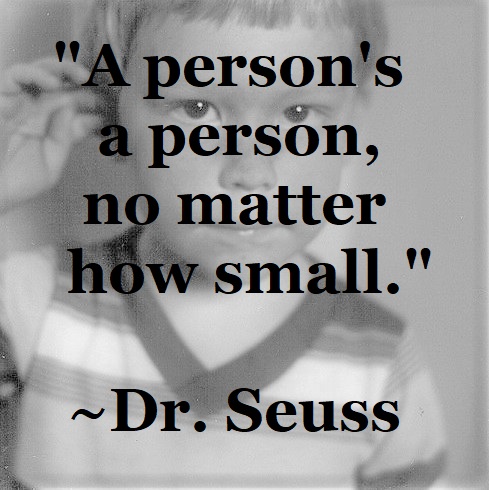
Dr Seuss - a person's a person no matter how small